Why Is the United States Allowing the UN to Influence the Next Generation of Gender Activists?
The United Nations Pact for the Future Uses Global Governance and Finance to Further Control Education and Mold the Next Generation of Leaders
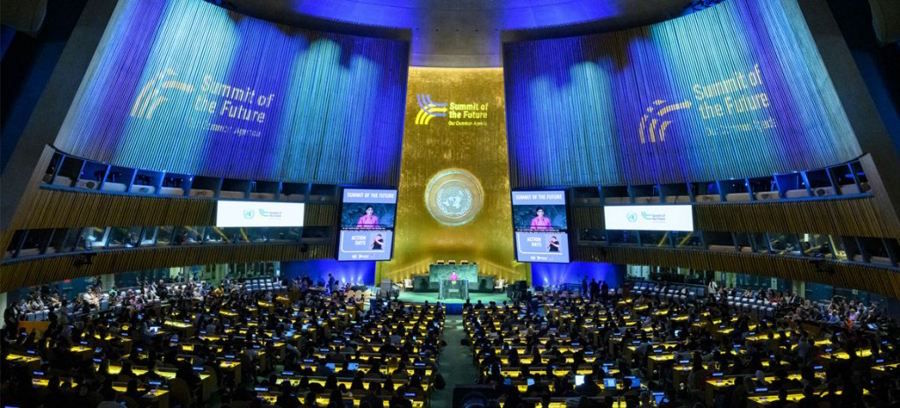
As recently reported by Truth In Education, the United Nations Pact for the Future is the organization’s newest iteration of its ongoing policy Agenda 2030, designed to accelerate implementation of the Sustainable Development Goals through global governance combined with active monitoring of progress. The Pact for the Future is the UN’s effort to energize the stalled Agenda 2030. One of the key ways this is done is through creating a global education system to shape the next generation of youth, which is then mentored and positioned as the next generation of global leaders.
The UN Pact for the Future brings promises to “increase access to quality, inclusive education and lifelong learning.” Doing so requires even stronger global control. In their own words, said many times over in the document, “We resolve to make the multilateral system, with the United Nations at its centre, more [e]ffective and capable of delivering on our promises, with strengthened accountability, transparency and implementation mechanisms…” To finance this increased global control, the Pact “call[s] for increased adequate, predictable and sustainable funding to achieve these goals,” provided by member nations, of which the United States is one of 193 members. Though the U.S. is not specifically funding the Pact for the Future under the current administration, money still flows to it through UN membership fees.
But what does this “quality, inclusive education” look like? The answer lies a bit deeper in the UN Pact for the Future’s foundational Common Agenda report, which in turn links to the Global Acceleration Plan for Gender Equality. This Plan outlines certain explicit goals for education, including providing comprehensive sexuality education along with “safe and legal access to abortion” for tens of millions of children, adolescents, youth, and women. It also includes activism aimed especially at young girls, helping them “increase the meaningful participation, leadership and decision-making power of girl leaders, and of women and feminist leaders, including those who are trans, intersex, non-binary…” This is done by “ensuring that schools and educational institutions are safe for all girls, adolescents and young women, and implement evidence-driven prevention strategies which promote gender equality, challenge gender stereotypes and foster equitable norms, attitudes and beliefs from a young age, including through gender sensitive curricula and comprehensive sexuality education.” This would further establish and normalize the UN’s view of gender identity, which is in direct contrast to the United States’ current policy of recognizing two biological sexes.
As these children receive their “quality, inclusive education” on a global scale, they are molded and recruited to shape the future of the global governance forum. The seeds of activism planted in the public education system are later reaped at a global scale in the Pact’s stated goals of “ensuring more youth engagement in the work of the United Nations and by increasing the representativeness, effectiveness and impact of youth engagement at the United Nations,” to include the appointment of youth delegates. This sets the stage for socialist youth activism from the moment children step into their first public education classroom.
Thus, in the UN Pact for the Future and its corresponding documents, the foundation is laid for the United States to ultimately implement the very gender activism that its citizens have been attempting to uproot from the public education system. Even as legislative efforts to protect girls’ sports and private spaces are finally yielding fruit in some states, the UN Pact for the Future, together with its related gender-equality initiatives, advances policies that recognize and support diverse gender identities, raising concerns about how these policies could influence American education and conflict with current U.S. policies recognizing two biological sexes.”
While the Supreme Court delivers victories for girls through recent rulings such as West Virginia v. B.P.J., the UN Pact for the Future asserts “the obligation of all States to comply with the decisions of the International Court of Justice in cases to which they are parties.” How long until the issues of youth sexuality, activism, and bodily rights enter the international judicial realm, in which the United States Supreme Court is no longer allowed to be the authority in interpreting international law and agreements? Although the U.S. does not currently accept the rulings of the International Court of Justice, it is technically a member of it and could potentially be required in the future to accept its judgments.
And to believe that there will be fair and fruitful debate in this regard is to be naïve, as the Pact seeks to establish itself as the authority on all subjects, stating unequivocally that “[e]very commitment in this Pact is fully consistent and aligned with international law, including human rights law.” One can already foresee that it will be the UN, not the member states, that will decide whether challenged actions comply with their interpretation of the law.
According to the Pact, sexuality rights are human rights. All youth will be taught to embrace them… and even fight for them. They will be taught to promote them in future international summits, policies, and legislation – all while the United States tolerates the UN’s influence and voluntarily relinquishes control over the education of its future citizens.
Just as Truth In Education asks parents to reflect upon why they entrust their child’s worldview formation to the public education system, we equally ask why our nation would adhere to the UN Pact for the Future and do the same on a global scale.
Rhonda Thomas is founder and president of Truth In Education.
This article is part of a new series which will be examining the UN Pact for the Future and its Annexes, with a focus on its impact on K-12 education.
From libertysentinel.org