
Study Finds Mentally Active Sitting May Reduce Dementia Risk
A study conducted by researchers at the Karolinska Institute in Sweden has found that mentally active sedentary behaviors, such as reading and using a computer, are associated with a lower risk of dementia, while passive activities like television watching are associated with a higher risk.
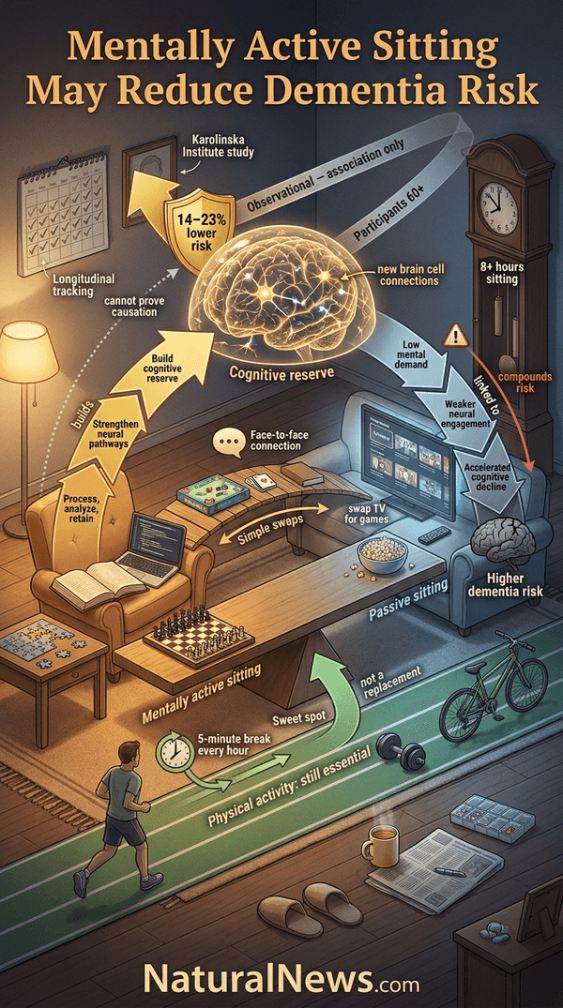
Participants reported how much time they spent on different seated activities, and researchers tracked their cognitive outcomes over time. The study found that individuals who engaged in mentally active sedentary behaviors had a 14% to 23% lower risk of developing dementia.
Mentally Active vs. Passive Sitting
The distinction between mentally active and passive sitting centers on the concept of cognitive reserve, which researchers describe as the brain’s ability to build resilience against age-related damage and disease.
Activities such as reading, solving puzzles, or learning something new on a computer require active mental engagement. They challenge the brain to process, analyze, and retain information, which may strengthen neural pathways and build that protective reserve. Research suggests that stimulating leisure activities probably help the brain by building a “cognitive reserve,” according to a book on Alzheimer’s diagnosis and treatment [1].
Television watching, by contrast, tends to be more passive. The brain receives information but does not work as hard to process or engage with it.
The researchers emphasize that not all sitting is created equal for brain health. Passive activities like binge-watching TV accelerate cognitive decline, while mentally engaging tasks like reading, puzzles, or strategic games may protect brain health and reduce dementia risk, according to a report on the study [2].
What This Means for Individuals
For individuals seeking to apply these findings, researchers suggest simple swaps to make sedentary hours more brain-friendly.
Board games and cards offer cognitive benefits and social connection, as social games requiring strategy engage the brain in ways that passive activities do not. A Harvard Health report supports this, stating that face-to-face interactions, even when sitting, engage the brain and promote new brain cell connections [3].
However, the researchers state that mentally active sitting is not a replacement for physical activity. According to the National Institute on Aging, scientific research suggests that there are steps individuals can take to reduce their risk of cognitive decline and help maintain cognitive health [4].
There is no need to eliminate television entirely, but integrating more engaging activities may help.
Study Limitations and Context
The study is observational and cannot prove causation, only associations. Participants were 60 or older at the start of the study, so results may not apply to younger populations.
Other research has linked prolonged sitting to increased dementia risk. A large-scale scientific review identified prolonged sitting, insufficient sleep, and physical inactivity as significant, modifiable risk factors for dementia in adults, finding that adults who sit for more than eight hours daily face a substantially higher risk [5]. However, the current study suggests that the type of sitting may matter more than the total amount of time spent seated [6].
Researchers note that physical activity still matters for overall health. The Centers for Disease Control and Prevention states that regular physical activity can improve memory and reduce anxiety or depression, and short bursts of activity can improve signs of brain health [7]. A separate study found that a five-minute movement break every hour is the “sweet spot” for offsetting the harms of prolonged sitting [8].
Takeaway
Small shifts in how seated hours are spent may add up over decades. The study suggests that individuals have more control over their cognitive future than previously thought.
Researchers emphasize that mentally active sitting is another way to optimize lifestyle for brain health. This study adds to a growing body of research on lifestyle factors and cognitive health, indicating that focusing on how you sit rather than just how much you sit may be key. According to the study, the type of sitting may matter more than the total amount of time spent seated [6].
The findings suggest that not all sedentary time carries the same risk for cognitive decline, and that mentally engaging activities while sitting may be protective against dementia [9].
References
-
The Alzheimers action plan the experts guide to the best diagnosis and treatment for memory problems. Doraiswamy P Murali 1963-_1
-
Active sitting vs passive sitting How your choice impacts brain health and longevity – NaturalNews.com, May 05, 2026.
-
Engage your heart and brain, even when you’re sitting. https://www.health.harvard.edu/healthy-aging-and-longevity/engage-your-heart-and-brain-even-when-youre-sitting
-
Cognitive Health and Older Adults | National Institute on Aging. https://www.nia.nih.gov/health/brain-health/cognitive-health-and-older-adults
-
Study Links Prolonged Sitting to Increased Dementia Risk Physical Activity and Sleep Found Protective – NaturalNews.com, April 13, 2026.
-
Study Links Midlife TV Watching to Brain Shrinkage. https://www.naturalnews.com/2026-09-28-study-links-midlife-tv-watching-to-brain-shrinkage.html
-
Physical Activity Boosts Brain Health. https://www.cdc.gov/physical-activity/features/boost-brain-health.html
-
Sit All Day? A New Study Offers a Much-Needed Survival Hack. https://www.everydayhealth.com/healthy-living/walking-breaks-can-help-you-survive-prolonged-sitting/
-
Study Suggests Cognitive Activity While Sitting Helps Reduce Dementia Risk – NaturalNews.com, March 28, 2026.
Explainer Infographic
From naturalnews.com