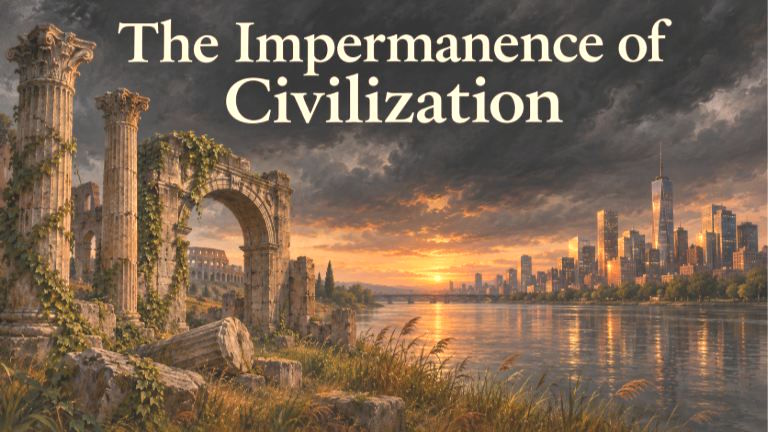
The Impermanence of Civilization
Now that the midterms are behind us, it’s a good time to reflect on the state of the union. Communists taking charge of “the land of the free and the home of the brave” is a stark reminder that one of the costliest assumptions societies can make is that civilization is permanent. Build enough highways, erect enough monuments, issue lots of official proclamations, and people begin to believe that civilization comes with a lifetime warranty.
The Romans probably believed this until they were faced with the unpleasant reality that marble buildings offer surprisingly little protection against bankruptcy, political corruption, and people arriving at the gates with swords. Americans should pay attention, because our assumptions are remarkably similar to those of the Romans.
Rome faced recurring difficulties financing its government machinery and wars, but America, regardless of which political party is in charge, has developed a more sophisticated arrangement than the Romans: Borrow staggering sums of money, call the resulting expenditures “investments,” and accuse people of lacking compassion if they express concern over saddling future generations with unpayable debt.
Like Rome, the United States possesses an extraordinary talent for treating tomorrow’s income as today’s spending account. The politicians who do the spending receive immediate applause, while the taxpayers’ grandchildren are presented with the invoice. Unfortunately, a public that is not informed about what government spends money on provides excellent working conditions for professional looters, the blatant Somali heist in Minnesota being a prime example of this.
Political battles are perhaps an even bigger threat to an empire’s existence than failed economic policies. Rome’s recurring struggles over who was entitled to rule helped weaken its ability to deal with problems beyond the palace. When controlling the government becomes more important than preserving the country, the country is headed for a migraine. Thus, it should not surprise anyone that America is coming apart at the seams as communist and crazies wrest control of the government from mainstream politicians.
To be sure, the United States still has constitutional protections in place that Rome lacked, but those protections do not include protecting taxpayers from out-of-control spending. Unfortunately, a powerful country can acquire obligations faster than it acquires the resources to meet them, and ordinary citizens are expected to believe that people who cannot manage a budget are uniquely qualified to manage the lives of others.
The Romans were also fond of entertainment spectacles, but nothing like the entertainment in modern-day America. Our entertainment industry delivers outrage, gossip, gambling, pornography, and celebrity wisdom without requiring anyone to leave their home. Entertainment is not a crime, but there’s something very wrong with a country when distraction becomes a substitute for responsible citizenship.
Rome also learned that maintaining power across enormous territories is expensive. Military strength requires economic strength, because you cannot indefinitely defend your country (let alone other countries) with borrowed money and speeches congratulating yourself on your leadership.
Finally, there is the dangerous belief that institutional prestige guarantees institutional competence. The truth is that an agency can have a distinguished seal, impressive headquarters, and a mission statement longer than the Constitution while accomplishing virtually nothing. Titles do not repair bridges. Credentials do not balance budgets. Committees do not become wise merely by meeting regularly.
The Roman Empire did not fall because somebody scheduled an insufficient number of diversity seminars or the Coliseum ran out of halftime entertainment. Its demise involved military misadventures, irresponsible economic decisions, political instability, and overall government failures. Unfortunately, most Americans have little or no knowledge of history, which is why they continue to be enamored with political philosophies that are guaranteed to enslave them.
Perhaps the most important lesson from the collapse of Rome is that accumulated greatness cannot permanently subsidize present foolishness. A country can live off inherited capital for a remarkably long period of time, which makes the process comfortable enough to deny and gradual enough to excuse.
Until, one day, the inheritance is gone. And by then, the politicians and bureaucrats responsible for the damage are also gone, and a new lineup of power-hungry folks are tasked with the job of explaining why the nation’s budget still cannot be balanced. Rome’s example should make us suspicious of any establishment that demands reverence while delivering nothing but deterioration, insolvency, and chaos.
America’s decline is not inevitable, but it certainly has been flirting with the idea for a very long time. The country retains immense productive capacity, technological ingenuity, constitutional remedies, and millions of people who still understand the relationship between effort and results. Those advantages matter, but so does the commitment to use them responsibly.
The solution is not complicated: Enforce laws consistently, bring spending and revenue into a sustainable relationship, reward productive behavior, demand competent government, and stop treating political loyalty as a substitute for good judgment. None of this requires an emperor, but it does require that positions of power be occupied by honest, competent, responsible adults.
The election blood bath we have just witnessed does not bode well for this requirement, but it does once again serve as a reminder that civilization is not permanent.
Robert Ringer is an American icon whose unique insights into life have helped millions of readers worldwide. He is also the author of two New York Times #1 bestselling books, both of which have been listed by The New York Times among the 15 best-selling motivational books of all time.
From robertringer.com