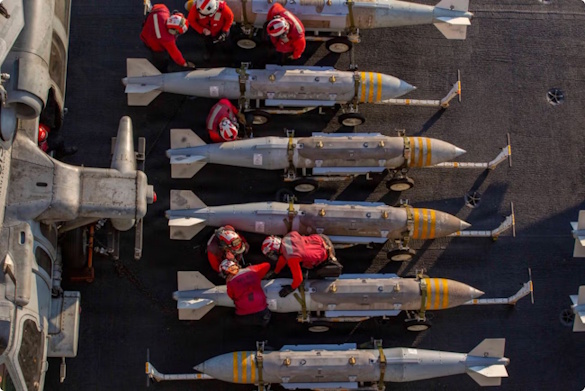
Why Isn’t Trump Finishing the Job in Iran? It’s not because the U.S. is out of ammo.
By Park MacDougald
In a completely unforeseen development, Lucy has once again yanked the football away from Charlie—sorry, President Donald Trump has once again backed away from his threats to annihilate Iran and opted for more diplomacy.
We were also shocked—shocked!—to learn one of the alleged reasons Trump decided to stop bombing Iran on Friday night: a shortage of key munitions. Indeed, The Washington Post, The New York Times, The Wall Street Journal, Axios, and CNN all ran stories over the weekend on the supposed “munitions” shortfall, reportedly raised by Chairman of the Joint Chiefs of Staff Gen. Dan Caine during a meeting with the president last week.
“Any major operation against Iran will face challenges because the U.S. munitions stockpile has been significantly depleted by Washington’s ongoing defense of Israel and support for Ukraine,” the Post reported Caine as telling the president. “Intensifying the war could dangerously drain the Pentagon’s already diminished stockpile of Patriot antimissile interceptors and other air defense munitions in the Middle East,” was the Times’ gloss on the same meeting. CNN and the Journal corroborated the claims about Caine, with CNN adding that Vice President JD Vance also warned Trump against resumption of the war. In an “analysis” article posted on Monday, CNN’s senior political reporter, Aaron Blake, argued that the question of “munitions stockpiles” had become “pivotal” to U.S. planning. Blake linked to an April analysis from CNN, which argued that there was now a “near-term risk” of the United States “running out of ammunition” in a conflict with a near-peer adversary such as China.
So, is the United States just too short on ammo to continue fighting? Unsurprisingly, the answer is that there is a partial truth here—but one wrapped in a whole lot of BS and spin.
The first point to make is that much of the media coverage—presumably guided by figures such as Colby—is intentionally conflating “munitions” with “air defense munitions,” used to defend against drones and ballistic missiles. U.S. inventories are classified, but most media coverage refers to estimates from the Center for Strategic and International Studies, which, according to CNN, “closely align” with classified U.S. data. Here’s a table on “key munitions” stockpiles from CSIS’s estimates published in April, at the conclusion of the intensive wave of fighting:
Center for Strategic and International Studies
Of these “key munitions,” the Tomahawks, JASSMs, and PrSMs are all high-end standoff (i.e., offensive) weapons, for which the United States has plentiful cheaper substitutes. The concern is specifically with high-end air defense munitions such as Patriots, THAADs, and SM-6s (used to defend ships from missiles and drones).
However, none of these shortages precludes further operations against Iran. In U.S. military doctrine, air defense is not intended to provide an indefinite shield against drone and missile strikes; given enough time, any sufficiently capable enemy can overwhelm air defenses—a problem known as “overmatch.” The purpose of air defenses is to protect U.S. and allied forces long enough to suppress and destroy the enemy’s launch capability. Indeed, this was precisely the point reportedly raised by CENTCOM chief Adm. Brad Cooper during the president’s recent war council. According to The Wall Street Journal, Cooper “believes the U.S. can cope with the limited stocks of Patriot and other air defense interceptors because stepped-up U.S. strikes, if they are approved by Trump, would blunt Iran’s ability to launch large numbers of missiles.”
What is true—and what we suspect was the basis of Caine’s reported warning—is that munitions shortages do somewhat raise the risk of combat operations. “The United States and Israel definitely still have the capacity to conduct operations, but they’re going to have to maybe accept a little bit more risk than they have in the past,” Colby Badhwar, an independent defense analyst and fellow at the Center for European Policy Analysis, told The Scroll in an interview. “They’re going to have to get in a little closer using things like small-diameter bombs, JDAMs, and glide bombs. The United States still has a lot of munitions available, but they definitely will have to be a little bit more judicious, perhaps, in how they execute and plan operations.” Indeed, as the CSIS report quoted above notes, “the United States has enough missiles to continue fighting this war under any plausible scenario.”
As for the claim that munitions shortages hurt U.S. preparedness against China, this is technically true—but misleading. Indeed, such claims repeat a line of argument frequently advanced by Undersecretary of Defense for Policy Elbridge Colby, a close ally of Vance and the other “restrainers” within the Trump administration. (Colby has been publicly supportive of the Iran war.) Indeed, since entering office, Colby has repeatedly attempted to use concerns about munitions as a pretext to attempt to starve Europe in general, and Ukraine in particular, of U.S. arms on the theory that the United States must conserve its stockpiles to deter China. But this is a “dishonest argument,” according to Badhwar. “At no point in living memory, since China first began to be identified as the main pacing threat, has the United States been adequately prepared to deal with the threat—not only in terms of munitions, but also in terms of the broader force structure. The U.S. armed forces don’t have the resources that they need to deal with the nightmare scenario,” he told The Scroll.
And what is that nightmare scenario? That the United States would have to simultaneously face threats in multiple theaters: i.e., some combination of China in Asia, Iran in the Middle East, and Russia in Europe. Thankfully, Russia is not currently much of a threat because it is tied down by Ukraine—no thanks to Colby and Vance, who have tried their best to cut off U.S. support for Kyiv. In the Middle East, meanwhile, the restrainer camp has settled on the argument that “munitions shortages” require the United States to allow the Iranian problem to fester, even as Vance demagogues against the only U.S. ally in the region capable of fighting on its own. Somehow, we are led to believe, allowing the enemy bloc to win in two theaters will make us more prepared to resist it in the third. Who can forget how we let Japan win to conserve ammo for Germany in World War II?
Of course, all this is a bit theoretical now, because we are under no illusions about the president’s intention of fighting a strategically coherent campaign in Iran or anywhere else. But that’s a problem of leadership. It’s not because we don’t have the ammo.
From tabletmag.com