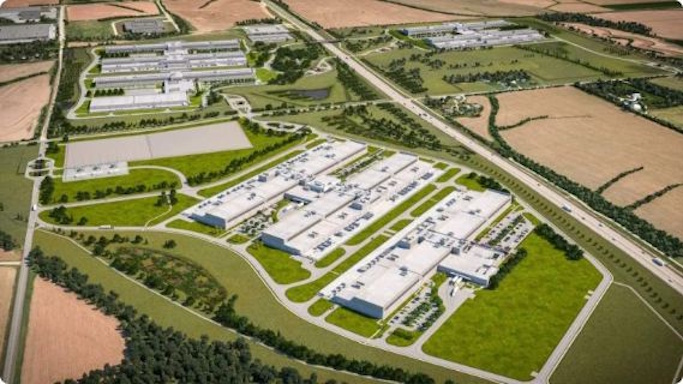
Data Centers in Idaho: Cost or Benefit?
By Brian Almon
Last week, I published an op-ed from Rep. John Gannon in which the Boise Democrat suggested that Big Data projects are on course to become the biggest public subsidy since the railroads of the 1800s, and that Idaho should determine whether they provide a public benefit before allowing them in our state:
Big Data advocates for the huge sales tax break told legislators that property tax reductions would be a huge benefit to local taxpayers. A Meta lobbyist told the House Revenue and Taxation Committee, according to minutes dated February 26, 2020, that there will be a “huge increase in the property tax base which will reduce the levy rate”. A national lobbyist for big data companies told the Senate Local Government Committee on March 25, 2025, that there would be a “massive” property tax reduction.
That won’t happen, according to Idaho Tax Commission representatives, because of the $400 million cap on an investment of $1 billion or more. Instead, the biggest companies in America, and in the world, will pay very little. It seems a fair ask that their presence benefit our small state, especially given the electricity, water, and noise issues they bring.
This session, bipartisan House Bill 897 passed the House unanimously. That’s right. Unanimous. It modernized Idaho’s approach by requiring payment of property taxes, establishing energy and water standards, and requiring regular public reporting. Unfortunately, the Senate diverted this reform attempt.
Data centers can benefit Idaho. They bring construction employment, expanded technology infrastructure, and opportunities for long-term economic growth. But initial investment alone is not success. Success means Idahoans are better off because these projects came here. That means fair taxation that gives property tax relief, affordable utility rates, safeguards our water and ensures our communities share in the benefits—not just the costs.
The reality is more complicated than either side often acknowledges. The $400 million cap unquestionably shifts some of the tax burden onto homeowners and small businesses. At the same time, it’s far from certain that facilities like Micron’s expansion or Meta’s data center would have been built in Idaho without the incentives that helped attract them. The real question isn’t whether the subsidies exist—they do—but whether the economic benefits justify their costs.
A deep dive into the numbers suggests that Rep. Gannon might actually be understating the disparity in taxation between these massive technology projects and the average homeowner’s property tax bill. The $400 million cap on Micron’s facilities means a Boise homeowner could be paying nearly $300 more per year than they would without the cap, while a Kuna homeowner stands to pay about $160 more per year now that the Meta data center has reached the same threshold. In fact, every property owner in Ada County is paying a little more than they otherwise would—but there’s a catch.
There are several things to unpack before diving into the numbers. First, a here’s a short refresher on how property taxes work:

If you want a more in-depth explanation, check out the Idaho State Tax Commission’s presentation to the Legislature during the 2025 session, which Rep. Gannon referenced in his op-ed:
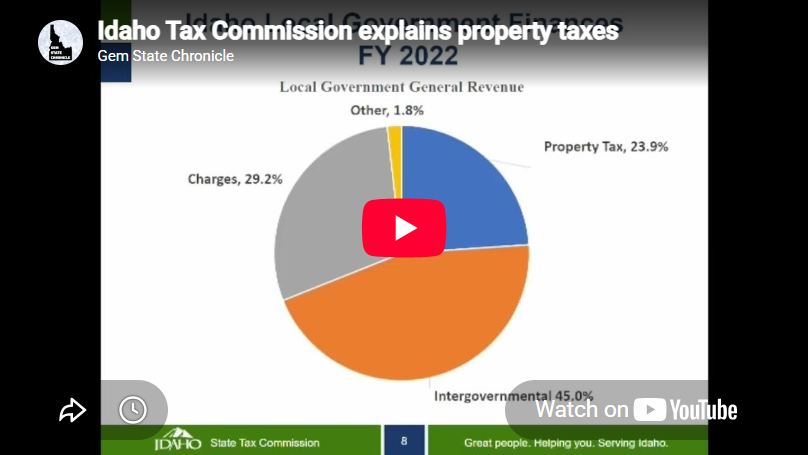
Because the levy rate is determined by dividing a taxing district’s budget by its total taxable value, any exemption on one property necessarily increases taxes on all others. The homeowner’s exemption, for example, shields $125,000 in taxable value on every owner-occupied home, shifting that portion of the tax burden onto rentals and businesses. Likewise, the Legislature’s decision to cap large technological projects at $400 million—regardless of how high their actual assessed value climbs—shifts part of the burden onto homeowners and small businesses.
I wrote about this exemption last year:
This isn’t the first time Micron has reaped the benefits of taxpayer subsidies. In 2008, the Idaho Legislature passed a bill granting a massive tax break to any corporation investing at least $1 billion in the state over seven years. The goal was to lure Areva, a French nuclear company, to build a facility near Idaho Falls. Areva didn’t bite—but Micron did. Having previously secured legislation to cap its taxable property value at $800 million, the company invested enough to qualify for the new law, which permanently capped its taxable property value at just $400 million. As a result, Micron paid less than $5 million in property taxes in 2019, about a quarter of what it would have owed the city of Boise and Ada County without the benefit of that law.
Micron isn’t the only tech company to benefit from Idaho taxpayers. In 2020, the Legislature passed another bill granting a sales tax exemption to companies investing at least $250 million in the state. Meta, the parent company of Facebook, used this tax break to begin construction on a new data center in Kuna. While the construction phase employs hundreds of workers, the facility will reportedly employ only about 100 people once operational, which seems to be a small number for such a large footprint.
These property tax breaks for corporations mean higher taxes for homeowners. Remember that property taxes are calculated by taking the budgets of each taxing district and dividing them by the total taxable value within that district. Capping Micron’s value at only $400 million means everyone else must shoulder that much more of the tax burden.
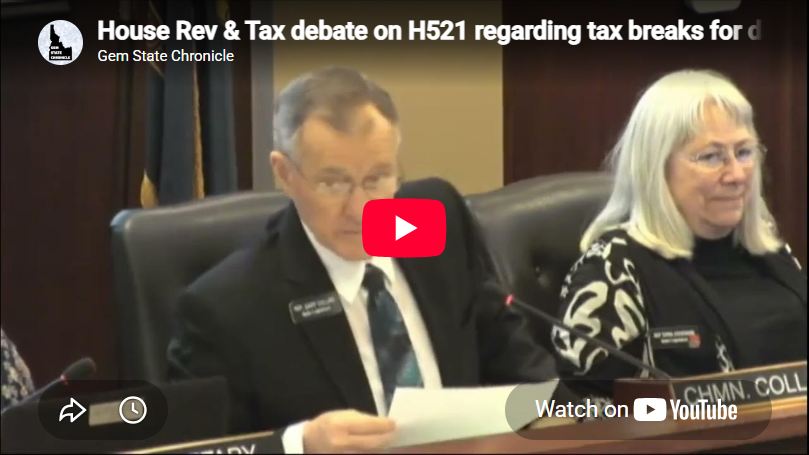
House Bill 521 established the sales tax exemption for data centers, which was a major reason Meta chose to build its new facility in Kuna rather than elsewhere. Meta lobbyists testified in favor of the bill, arguing both that it would provide property tax relief for homeowners and that, without the tax incentives, Idaho would be a non-starter for projects such as this. Watch the full debate in House Revenue & Taxation here:
According to my analysis, the total assessed value of all property within Boise city limits in 2025 was $73.98 billion, with just over $51 billion of that marked as taxable. More than $4 billion is listed as “other statutory exemptions,” which almost certainly refers to the two Micron facilities in Boise. The original fabrication plant was valued at $1.86 billion in 2019, meaning that without the $400 million cap, the corporation would have owed $20.32 million in property taxes. Instead, Micron paid only $3.4 million in 2024.
The difference between what Micron would pay without the cap and what it actually pays must be made up by someone. That burden falls on other business owners and homeowners in Boise and amounts to roughly $300 per year, depending on the value of the property.
However, this tells only half the story.
Big corporations such as Micron and Meta respond to incentives. Right now, states—and even countries—are competing for their business. Remember how the Meta lobbyist told legislators that, without the sales tax exemption, building in Idaho would be a non-starter. Micron was already here—founded in a Boise basement in 1978—but would it continue expanding in Idaho without taxpayer subsidies? Congress passed the CHIPS Act in 2022, which, among other things, provided Micron with $6.1 billion in exchange for breaking ground on a new fabrication plant in Boise and two more in New York. The stated purpose of the CHIPS Act was to encourage technology companies to build in America rather than overseas.
Without the CHIPS Act and the $400 million property tax cap, it seems unlikely Micron would have built a second plant in Boise. That means the alternative to a valuable property being capped at $400 million in taxable value is not necessarily taxing its full $2 billion—or whatever its current valuation may be. The opportunity cost may instead be no facility at all: a vacant parcel with comparatively little taxable value.
The same dynamic exists in Kuna. It’s easy enough to calculate that, without the $400 million cap, Meta’s data center could generate many times as much in property taxes, resulting in substantial relief for homeowners. Right now, the average Kuna property owner pays roughly $160 to $180 more per year because of the cap—a smaller dollar amount than in Boise, but a larger share of the overall tax burden.
But without those incentives, would Meta have built here in the first place? The company did not initially reach the $1 billion valuation threshold required to trigger the cap, but it did take advantage of the sales tax exemption to establish its presence and likely anticipated eventually crossing that threshold. Once again, the opportunity cost matters. Without those incentives, the alternative may not have been greater relief for Kuna homeowners, but no data center—and therefore higher taxes than would otherwise have resulted.
Kuna did receive other benefits between 2022, when the project was announced, and 2025, when it reached the $1 billion valuation threshold. The company agreed to an $8.2 million one-time mitigation payment to the city, along with covering the cost of a $50 million water and sewer system to support the project. In 2023, the Legislature passed House Bill 328, ensuring that any data center receiving the sales tax exemption could not be placed in its own urban renewal district, such as the one created for Chobani in Twin Falls. As a result, all property tax revenue generated by the data center is distributed among the applicable taxing districts rather than being confined to specific projects related to the data center itself.
By 2025, the valuation of the Meta data center crossed the $1 billion threshold, capping its taxable value at $400 million. For two or three years, however, Kuna property owners benefited from the facility’s full assessed value before the cap took effect.
Another company, Diode Ventures, has announced a $2 billion data center project in Kuna, which will almost certainly qualify for the same cap. Once again, though, the relevant question is opportunity cost: are Kuna and Ada County residents better off with another $400 million in taxable value, or with no project at all?
Sentiment in the Legislature has waxed and waned between those who believe these tax exemptions are necessary to attract projects that benefit Idaho residents and those who view them as excessive corporate welfare. Last session, the House unanimously passed House Bill 897, which attached additional conditions to the sales tax exemption already in law and would have indexed the $400 million property tax valuation cap upward for Micron and Meta while sunsetting the exemption entirely for any future project. In the Senate, however, H897 was heavily amended. The sunset and indexing provision was removed, along with transparency and reporting requirements related to other tax exemptions. The amended bill passed the Senate but was never returned to the House for concurrence. This is the legislation Rep. Gannon referred to in his op-ed.
Rep. Chris Bruce, who sponsored H897 in 2026 as well as the similar House Bill 315 in 2025, has a unique connection to the Meta and Diode projects. He serves on the Kuna City Council, which approved both developments, although Bruce voted against the Diode project. Meta’s project was approved before he joined the council.
The numbers are clear: every Ada County property owner—but especially those in Boise and Kuna—is subsidizing Meta and Micron. Yet, as Thomas Sowell observed, there are no solutions, only tradeoffs. Are these subsidies a worthwhile tradeoff for the jobs and investment they have brought to the region? Should such subsidies continue indefinitely for companies that have already built here? Should these tax incentives remain on the books to attract future development? Should the $400 million cap be indexed to inflation or tied to some measure of countywide property values?
If techno-optimists are correct, the world is entering a revolution in artificial intelligence and technological innovation. That means more data centers, more fabrication plants, and more multi-billion-dollar investments across the nation and around the globe. What role should Idaho play in this brave new world? Is it our destiny to transform from an agricultural state into a technological one? Or can those two identities coexist, each serving the people of Idaho in its own way?
These are the questions policymakers must continue to answer over the coming years. The Idaho our children and grandchildren inherit will depend on the choices we make today. Let’s make them good.
Enjoyed this article? Get more Idaho political news in your inbox.
The Gem State Chronicle delivers daily analysis, op-eds, press releases, and Idaho Insider updates — free to your inbox.
Free newsletter · Unsubscribe anytime · View on Substack
Gem State Chronicle is a reader-supported publication. To receive new posts and support my work, consider becoming a free or paid subscriber.
About Brian Almon
Brian Almon is the Editor of the Gem State Chronicle. He also serves as Chairman of the District 14 Republican Party and is a trustee of the Eagle Public Library Board. He lives with his wife and five children in Eagle.