A Tale of Two Countries
On the 250th anniversary of the Declaration, America’s story is cast as either triumphant inheritance or unfinished grievance, with no neutral ground in between.
So here we are: July 4, 2026, the 250th anniversary of the signing of the Declaration of Independence. For the last several weeks, a crescendo of celebratory events has been building: fireworks without end, day-long flyovers of military aircraft, speeches, parties, and conferences galore. Nor have the celebrations been confined to America. All across the world, spectacular light shows, fireworks, and other red, white, and blue extravaganzas have rung out their grateful and congratulatory chorus. And quite right, too. For the Declaration marked the opening foray of what would become the greatest country the world had ever seen.
At least, that is how a large portion of the world’s population sees it.
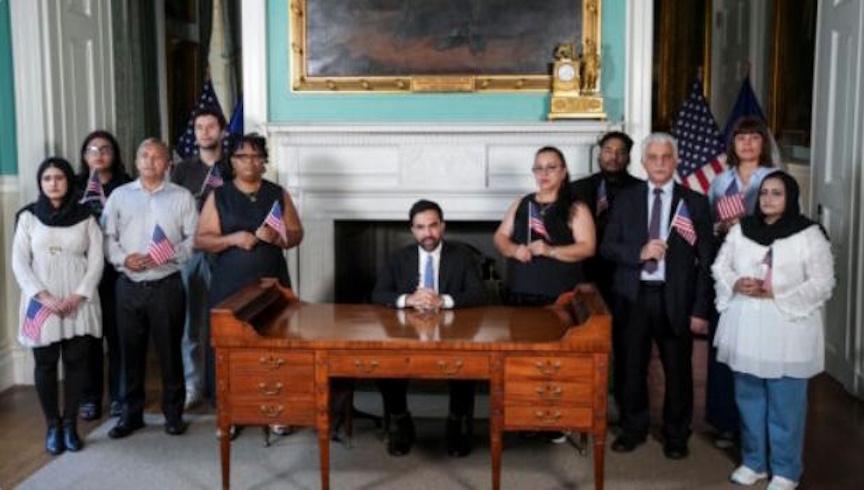
Others were more astringent in their reaction. On Friday, July 3, Zohran Mamdani, New York City’s smiling Uganda-born mayor, sat in front of George Washington’s desk in the mayor’s office at City Hall and delivered a dark admonition. Flanked by 10 rather grim-looking newly naturalized immigrants, each of whom clutched a tiny American flag, he folded his hands and dispensed a 1619 Project-style sermon to America on the occasion of its first quarter-millennium.
Centuries ago, Mamdani intoned, ships made their way into New York Harbor. And then what? “They saw land lush and teeming with life. They saw men waiting at the docks to take them into bondage. They saw tenements rife with squalor. . .”
Who dragged the needle across that spinning record? And so this wretched speech continued. America had great promise, Mamdani admitted. The Declaration enunciated noble ideals. But here on the 250th anniversary of that document, I, Zohran Mamdani, am here to tell you about America’s systemic failures. Strophe: New arrivals “saw merchants peddling their wares on the docks, streets being laid out on a grid, buildings rising into the clouds.” Antistrophe: “They could not yet see the nativism they would face—the jobs they would be refused, the landlords who would not rent to them, and the abject labor and living conditions they would withstand.” Happy birthday, what?
And what about the vaunted “American Exceptionalism?” Here, Mamdani went to school with Barack Obama. The irony is, Mamdani said, “that the story of America has so often been written by those who were told by others with power and influence and wealth that they were anything but exceptional.”
For generation after generation, we have been told that when the world has sent its people to our shores, it has not sent its best. [Cue the Donald Trump caricature.] It sent Puritans and Sikhs and Quakers and Muslims and Jewish people who were banished for praying the wrong way, worshipping the wrong gods, angering the wrong people. It sent peasants and serfs from slums and shtetls who were treated as less because they hardly owned clothes, let alone land. It sent immigrants for whom power was something someone else had. We are told that America is exceptional because we are richer, stronger, more powerful than everyone else.
It’s Us versus Them, Comrade, and class warfare must go on forever. For the powerful, quoth Mamdani, America “is an arena of supremacy, where only a select few are allowed freedom, where not all are created equal. America, if you ask them, becomes less the more people it welcomes. America, they will tell you, belongs only to those with the right accent or the right shade of skin.” And what shade would that be, Kemo Sabe?
New York, according to Mamdani, is “a city of contradictions within a nation of contradictions.” I suppose that means we are talking about a city and a country populated by human beings. But that slick—ultimately specious—formulation was the perfect segue to a tired and tawdry series of oppositions. “We see the wealthiest country in the history of the world—one where children go to sleep hungry while the world’s first trillionaire hungers for more.” Anyone particular in mind with that invocation of trillionaires, Zohran? “We see monopolies that dominate every industry and oligarchs who buy elections.” Like George Soros? “We see masked agents terrorizing our streets [i.e., enforcing the law], eating food cooked by our undocumented [read: “illegal”] neighbors before spiriting them away in unmarked vans. [How would you have them marked?] We see a nation whose immense wealth has been built by those with calloused, dirt-streaked hands—those who toil on factory floors and chisel into stone—and we see a nation that has allowed so much of that wealth to be held instead in the soft hands of a precious few.” “Soft hands,” eh?
Since Mamdani pointedly alluded to Elon Musk, it seems only fair to note that Musk seized on the operative word in this last graph, “build.” “Mamdani has built nothing,” Musk noted in a comment on the mayor’s speech. He is “a taker, never a maker.” Stephen Miller, Trump’s deputy chief of staff, sounded a kindred note that same day in a speech before National Guard soldiers. “All of civilization,” Miller said, “can be fundamentally divided into two groups of people: builders and destroyers. The people who do the work to build, sustain, and nurture civilization . . . and those who only destroy. Who litter, who rob, who graffiti, who deface, who degrade.”
Except among true believers, Mamdani’s speech instantly provoked condign ridicule and mockery. One of the keenest comments on Mamdani’s speech was made by the commentator who goes under the sobriquet “Cynical Publius.” “A key thing to understand about Marxists,” he wrote on X, “is that they use the language of the oppressed so that they can be the oppressor.” Bingo. Keep that in mind when Mamdani’s “warmth of collectivism” results in the expropriation of your property, stifling regulation, higher taxes, less air conditioning, and greater levels of street violence.
Zohran Mamdani, a self-proclaimed “Democratic Socialist,” provided one vision of America. Donald Trump, speaking that same day at Mt. Rushmore, provided another, very different vision. It was one of Trump’s briefest but also one of his most powerful speeches. He began by noting what a magnificent anniversary this was: imagine 250 years of extraordinary prosperity, martial vigor, and unparalleled generosity to others. The main burden of Trump’s remarks, however, was to sound an alarm about those who go in for euphemistic talk about the surprising return of “socialism” in blue redoubts across the country. Trump, following George Orwell’s advice to call things by their real names, shed the euphemism and called the danger what it is: “communism.” There is, Trump said, “a resurgence of the communist menace in our land—including from newcomers to our country who embrace ideas totally opposed to our way of life.”
Trump made three key points.
First, while communists continuously rail against the supposed depredations of America, they completely gloss over the crimes of communist societies. “Even while the Radicals and Extremists attack our incredible history at every turn, they are SILENT on the miserable history of Communism itself. Their system has led to more death and destruction than any system ever tried—it killed 100 million people in the last century.” Don’t believe that number? Check out The Black Book of Communism, a handy and authoritative compendium of Communist atrocity.
Second, communist mendacity is directed not only or primarily toward America’s past. It is ultimately directed toward our future. Distorting the past is a potent weapon in the war to control the future.
As for those who would peddle Marxist lies about our heritage—who tell our children that we live on stolen land, or that our heroes were oppressors—they are doing something much worse than slandering our past. They are attacking our future. They are trying to tear down the American Character, to destroy the people who declared Independence, crossed the Delaware, settled the West, and conquered the skies. But we will never let that happen.
The bottom line—and let it be inscribed on the national lintel—is that “You can be loyal to Karl Marx, or you can be loyal to America. You can be a Communist, or you can be a Patriot. You cannot be both.”
Third, the ideology of communism (a.k.a. “Marxism,” “socialism,” etc.) cannot cohabit with a republican regime based on limited government and the rule of law because the essence of communism is totalitarian. “Such doctrines can be given no quarter in a Democracy, because the first thing they do when they get into power is turn around, and destroy it—just as Communists have done in other countries all over the world.”
It is indeed curious that just as America begins to recover its political specific gravity, shedding the smothering carapace of top-down regulatory excess and the insanity of woke ideology, pustules of socialist or communist hysteria pop up in susceptible municipalities. I suspect that, like some virulent fevers, it will run its course and then die out. But Trump is right to warn about its danger because, ignored, it might well turn into the sort of all-consuming illness that the twentieth century saw ravage many other societies across the globe. Zohran Mamdani still trots out his ensorcelling smile when the cameras are running. But be warned. Behind that seductive mask are all the hideous evils that Donald Trump adduced in his brief speech.
By submitting your information, you agree to receive exclusive AG+ content, including special promotions, and agree to our Privacy Policy and Terms. By providing your phone number and checking the box to opt in, you are consenting to receive recurring SMS/MMS messages, including automated texts, to that number from my short code. Msg & data rates may apply. Reply HELP for help, STOP to end. SMS opt-in will not be sold, rented, or shared.
About Roger Kimball
Roger Kimball is editor and publisher of The New Criterion and the president and publisher of Encounter Books. He is the author and editor of many books, including The Fortunes of Permanence: Culture and Anarchy in an Age of Amnesia (St. Augustine’s Press), The Rape of the Masters (Encounter), Lives of the Mind: The Use and Abuse of Intelligence from Hegel to Wodehouse (Ivan R. Dee), and Art’s Prospect: The Challenge of Tradition in an Age of Celebrity (Ivan R. Dee). Most recently, he edited and contributed to Where Next? Western Civilization at the Crossroads (Encounter) and contributed to Against the Great Reset: Eighteen Theses Contra the New World Order (Bombardier).