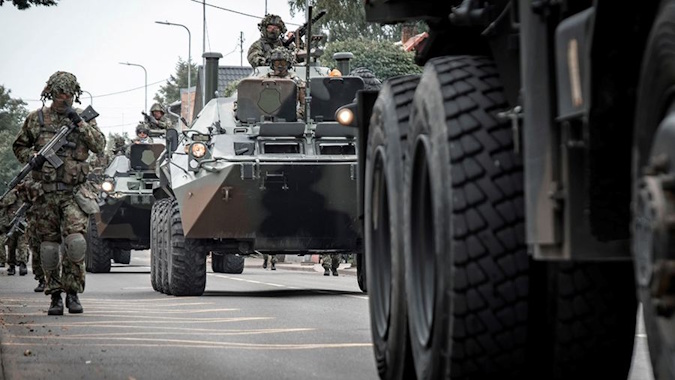
U.S. and Ecuador launch joint military ops against narco-terrorist cartels
By Willow Tohi
- The United States and Ecuador have initiated joint military operations against designated narco-terrorist organizations within Ecuador.
- The operations follow high-level meetings between U.S. Marine Corps Lt. Gen. Francis Donovan and Ecuadorian President Daniel Noboa.
- U.S. officials emphasize the role is supportive, with no American troops in direct combat.
- The action is part of a broader U.S. strategy, including classifying Ecuadorian cartels as Foreign Terrorist Organizations.
- The move addresses Ecuador’s severe security crisis, where cartels have destabilized the nation through violence and corruption.
In a significant escalation of international security cooperation, military forces from the United States and Ecuador have launched joint operations against powerful narco-terrorist organizations inside the South American nation. The action, announced by U.S. Southern Command on March 3, marks a tangible deepening of the U.S. commitment to supporting Ecuadorian President Daniel Noboa’s declared war on cartels that have plunged his country into violence. While operational details remain closely held, the move signals a strategic shift from advisory support to active, partnered military engagement against groups officially designated as terrorist threats to regional stability.
From advisory to operational partnership
The joint operations represent the latest and most direct phase in a security relationship that has intensified over the past year. This partnership was formally expanded in July 2025 when U.S. Secretary of Homeland Security Kristi Noem and President Noboa signed an agreement to enhance law enforcement coordination, including embedding Ecuadorian officers within U.S. agencies to improve threat tracking. The current military collaboration was preceded by a two-day visit to Quito by Marine Corps Lt. Gen. Francis Donovan, commander of U.S. Southern Command, who met with Noboa and senior defense officials to finalize plans. A Pentagon spokesperson clarified that the U.S. role in these operations is supportive and does not involve American troops in direct combat.
The designated enemy: Cartels as terrorist organizations
The targets of these operations are not merely criminal gangs but entities formally recognized by the U.S. government as foreign terrorist organizations. In September 2025, the Trump administration designated two of Ecuador’s most violent cartels, Los Choneros and Los Lobos, as terrorist groups. This classification was based on their campaigns of intimidation and violence against the Ecuadorian state, including attacks on public officials, security forces, judges and journalists. The designation provides a broader legal and operational framework for U.S. involvement, framing the conflict as a counter-terrorism effort rather than solely a narcotics interdiction campaign. It also follows other regional actions, such as the capture of Venezuelan leader Nicolás Maduro, underscoring a focused U.S. policy against regimes and groups deemed destabilizing in the hemisphere.
Ecuador’s descent and call for help
The necessity for such drastic measures stems from Ecuador’s rapid transformation from a peaceful nation into a key battleground in the international drug trade. Positioned between cocaine producers Colombia and Peru, Ecuador’s ports have become a primary export hub, with an estimated 70% of the world’s cocaine passing through its borders. The influx of wealth and power to cartels triggered an explosion of violence, including prison massacres, assassinations of political figures and daily terror in cities. President Noboa, who declared an “internal armed conflict” against these groups, has repeatedly appealed for international military assistance, arguing that Ecuador’s security forces are outmatched by the thousands-strong, well-armed narco-terrorist armies. This week’s operations fulfill his March 2025 public plea for U.S. special forces support to dismantle the criminal networks.
A strategic calculus for regional security
For the United States, the partnership with Ecuador addresses several intertwined national security interests. First, it aims to disrupt the flow of narcotics at a major chokepoint before they reach North American streets. Second, it seeks to stabilize a friendly democratic government threatened by collapse from criminal insurgency, preventing a potential failed state on the continent. Finally, it counters the influence of transnational criminal syndicates and their often-overlapping connections with other adversarial networks. The cooperation builds upon ongoing initiatives like Operation Pacific Viper, a U.S. Coast Guard-led campaign targeting drug trafficking in the Eastern Pacific. Success in Ecuador would deny criminal groups a critical logistics base and demonstrate the effectiveness of a sovereign nation-led, internationally supported counter-terrorism model.
A high-stakes commitment to improving stability
The launch of U.S.-Ecuador joint military operations is a pivotal moment in the Western Hemisphere’s fight against narco-terrorism. It moves the alliance beyond intelligence sharing and training into a realm of coordinated, tactical action against a common enemy. The outcome carries high stakes: for Ecuador, it is a bid to reclaim its territory and institutions from criminal control; for the United States, it is a test of a security strategy that blends law enforcement, military support and diplomatic pressure to confront hybrid threats at their source. While the path ahead remains dangerous and complex, this collaborative offensive represents a definitive step in answering a beleaguered ally’s call and confronting the networks of violence that threaten the security of both nations.
Sources for this article include:
TheEpochTimes.com
SouthCom.mil
Kiro7.com
From naturalnews.com