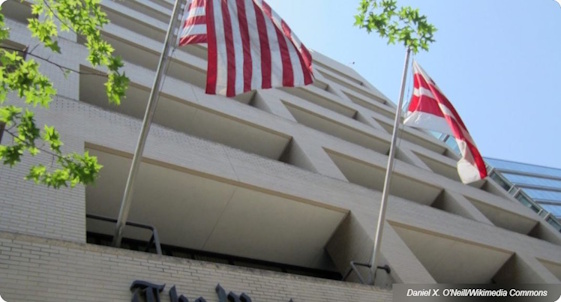
Washington Post Axes One‑third of Staff as Legacy Media Collapse Continues
By Paul Dragu
In another sign of legacy media’s continuing diminishment, news broke on Wednesday that The Washington Post is firing 30 percent of its workforce. That comes to about 300 of its 800 reporters.
Post executive editor Matt Murray said “that the company had lost too much money for too long and had not been meeting readers’ needs.” He implied that part of the problem is that the newspaper is too ideologically one-sided. “Even as we produce much excellent work, we too often write from one perspective, for one slice of the audience,” he said. He added “that all sections would be affected [by the cuts] in some way, and that the result would be a publication focused even more on national news and politics, as well as business and health, and far less on other areas.”
The Post is in a tough spot. Ownership has pushed for a more politically balanced reporting approach over the last few years, but that appears to have alienated some of its loyal readers while failing to bring in others. The idea behind a more moderate approach was to widen its subscriber net. But the paper has such a long history of being a left-wing publication that it will be tough for more conservative people to shake that perception. Moreover, the paper is trying to give its brand a makeover when traditional-style media in general is plummeting.
Losing Readers Nothing New
The publication lost tens of thousands of subscribers in 2024, after it announced before the U.S. presidential election that it would not endorse a presidential candidate. The paper had been endorsing candidates since the 1970s. All of them happened to be Democrats, which prompts the question of what legitimate value there is to an automatic endorsement. The paper’s billionaire owner, Jeff Bezos, pushed the Post to halt those endorsements. Bezos bought the Post in 2013, and had been trying to pull it a little more to the right from its long-standing ultra-left position. He also pressured the opinion section last year to focus on “personal liberties and free markets,” which apparently so outraged the editor in charge of that section that he quit.
But the paper was hurting even before 2024. Like so much of legacy media, it had been losing trust — and readers — for many years as part of a larger trend. A Gallup poll from October of last year revealed that trust in legacy media is at a record low:
Americans’ confidence in the mass media has edged down to a new low, with just 28% expressing a “great deal” or “fair amount” of trust in newspapers, television and radio to report the news fully, accurately and fairly. This is down from 31% last year and 40% five years ago.
The poll went on to point out another important component that suggests how the media landscape will shape out. “In the most recent three-year period, spanning 2023 to 2025, 43% of adults aged 65 and older trust the media, compared with no more than 28% in any younger age group.” In the early 2000s, “Americans in all four age groups expressed relatively similar levels of confidence in the media, at just above 50%.” However, since then, “confidence among all four groups has gradually declined — but less so among Americans aged 65 and older.”
As older Americans pass away, expect traditional media to continue losing influence.
Changing Landscape
The media landscape has been going through significant changes for about two decades now. Starting in the early to mid-2000s, the internet began cutting into newspaper advertising revenue thanks to Craigslist and similar classified-style websites. Advertising was always the main revenue source for newspapers. Then social media, particularly Facebook and Twitter, emerged as conduits for the publications. Fewer people were going directly to the newspapers, opting instead to get there only after being redirected by their social media feed.
In the next phase, “lay” newsmakers started sprouting up, people without a printing press or, in many cases, even a website. People just started publishing newsy posts on social media and the public paid attention. And most recently, podcasters have emerged as a major force in the news media world. Popular podcasters, which heavily utilize social media, garner millions of listens per episode, usually more than the number of people who watch a prime-time legacy media show episode or read a Post article.
Legacy Losing Power
In short, as some have described it, news production has become “democratized.” The legacy-media gatekeepers have lost their power. A good illustration is Donald Trump’s successful 2016 presidential campaign, in which he essentially circumvented the legacy media and built massive public support by manic use of his Twitter account. That is also why he was banished from the platform after the 2020 rigged election, because he was broadcasting a forbidden narrative in an unfiltered fashion.
The same thing happened to millions of people around that time. Stolen elections, the uselessness of tissue face masks in restricting a microbial virus, the harm of the Covid-19 “vaccines,” and a number of related talking points were banned. And, as we later learned, they were cut because agents from various government agencies — including the FBI, CIA, and State Department — embedded themselves into social media platforms to dictate censorship. The censorship has largely subsided since then, but there is no guarantee things will remain that way.
There’s an old saying on Capitol Hill that goes like this: “The New York Times is the CIA’s house organ, and The Washington Post is the voice of the State Department.” The Post is part of the “Mockingbird Media,” a reference to Project Mockingbird, a long-running CIA program launched in 1950 to hijack American media. It’s been very successful. Based on various reports, we’ve learned that at least 400 American journalists carried out assignments for the CIA.
“Ruling Class Journalists”
In 1993, the Post’s then-ombudsman Richard Harwood published an editorial titled “Ruling Class Journalists.” The piece was an astounding admission against interest. Harwood essentially confirmed that members of the globalist Council on Foreign Relations were “the nearest thing we have to a ruling establishment in the United States.” He pointed out myriad offices held by CFR members.
“The president is a member,” he wrote. “So is his secretary of state, the deputy secretary of state, all five of the undersecretaries, several of the assistant secretaries and the department’s legal adviser. The president’s national security adviser and his deputy are members. The director of Central Intelligence (like all previous directors) and the chairman of the Foreign Intelligence Advisory Board are members.” On and on he went, mentioning also the secretary of defense; three undersecretaries and at least four assistant secretaries; the secretaries of the departments of housing and urban development, interior, and health and human services; the chief White House public relations man, etc.
CFR members were peppered throughout not only the most influential private and government institutions, but also media. “What is distinctively modern about the council these days is the considerable involvement of journalists and other media figures, who account for more than 10 percent of the membership,” he wrote. Harwood then cited a long list of upper-tier media figures who were part of the globalist club:
In the past 15 years, council directors have included Hedley Donovan of Time Inc., Elizabeth Drew of the New Yorker, Philip Geyelin of The Washington Post, Karen Elliott House of the Wall Street Journal and Strobe Talbott of Time magazine, who is now President Clinton’s ambassador at large in the Slavic world. The editorial page editor, deputy editorial page editor, executive editor, managing editor, foreign editor, national affairs editor, business and financial editor and various writers as well as Katharine Graham, the paper’s principal owner, represent The Washington Post in the council’s membership. The executive editor, managing editor and foreign editor of the New York Times are members, along with executives of such other large newspapers as the Wall Street Journal and Los Angeles Times, the weekly newsmagazines, network television executives and celebrities — Dan Rather, Tom Brokaw and Jim Lehrer, for example — and various columnists, among them Charles Krauthammer, William Buckley, George Will and Jim Hoagland.
This constitutes a “ruling class,” he concluded. The journalists at these papers “do not merely analyze and interpret foreign policy for the United States; they help make it.” Philip Graham, by the way, the former owner of the Post, was not only a CFR member but an operative for the CIA, as we reported in 2017.
The War Over Media Is Not Over
The fall of legacy media is one of the best developments for anyone who values liberty, transparency, and even accountability. But there is no way the Deep State is going to sit by idly while people learn about the treacherous, diabolical, and traitorous campaigns they’ve carried out against the very nations they were tasked with serving.
The Deep State will continue to push laws for social media censorship, as it’s had some success with in Europe. It’ll continue to flood new media with noise and disinformation, the goal being to create confusion. It’ll continue recruiting influencers to pose as organic opinion molders. It’ll continue flooding social media threads with bots to create the appearance of support for their preferred narrative. In short, the information battle is not over — it is simply closing on one front and opening on another.
See More About:
MediaPropagandaWashington Post
Paul Dragu
Paul Dragu is a senior editor at The New American, award-winning reporter, host of The New American Daily, and writer of Defector: A True Story of Tyranny, Liberty and Purpose.
Published with permission of thenewamerican.com