The Capture of Maduro and Avoiding Another Iraq Nation-Building Debacle
Trump’s capture of Maduro resets hemispheric security, aiming to expel U.S. adversaries from Venezuela while forcing reform without repeating the nation-building failures of Iraq.
By Fred Fleitz
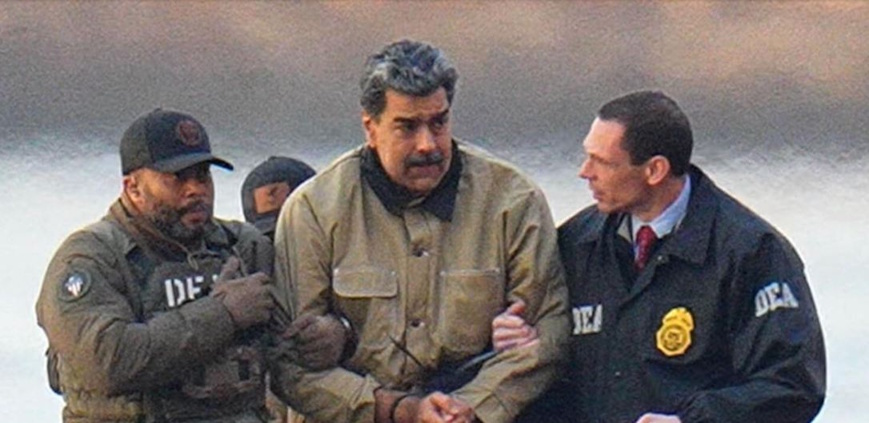
The massive US military operation ordered by President Trump to apprehend former Venezuelan leader Nicolas Maduro and his wife from their heavily guarded residence was a game-changer for regional and global security. The Trump administration’s next steps will be crucial to ending the threats from Maduro’s criminal regime without repeating the disastrous nation-building effort in Iraq after the second Gulf War.
The operation to capture Maduro removed a narcoterrorist dictator from power and set the stage for the US to restore stability and security to the Western Hemisphere by ending the flow of narcotics, criminal gangs, and illegal migrants into the US from Venezuela.
More importantly, Maduro and his predecessor, Hugo Chavez, made Venezuela into a base of operations that Russia, China, and Iran—as well as drug cartels and Hezbollah—were using to undermine American security and promote their influence in Central and South America. China has given or loaned over $100 billion to Venezuela since 2000 to install anti-US dictators and secure access to Venezuelan oil. Russia loaned and/or made payments to Venezuela totaling $17 billion to $34 billion since 2000. Cuba also has a large presence in Venezuela, providing the regime with troops, intelligence officers, and doctors.
This is why the Trump administration gave an ultimatum to the post-Maduro government: it must expel all suspected spies and other intelligence agents from China, Russia, Cuba, and Iran or face a second US military operation.
The Trump administration’s decision to retain and work with Delcy Rodriguez, Maduro’s vice president and now Venezuela’s acting president, has perplexed many observers. Trump has also been criticized for his decision not to try to install as Venezuela’s president either Edmundo González, the actual winner of the 2025 presidential election, or opposition leader and Nobel Peace Prize winner María Corina Machado.
Instead, the Trump administration is using the US blockade of Venezuelan oil shipments and the threat of a second round of US military force to pressure acting president Rodriguez and the remnants of the Maduro regime to carry out political reforms, rebuild the economy, and set the stage for a democratic transition and elections.
This strategy reflects lessons the US learned after it occupied Iraq and ousted Saddam Hussein from power in 2003. The post-war nation-building effort in Iraq forced tens of thousands of Ba’ath Party government officials to resign and dissolved the Iraqi army. This led to a power vacuum and anarchy, which resulted in a brutal insurgency, a civil war, and the rise of Al-Qaeda in Iraq (AQI) and later ISIS.
President Trump does not want a repeat of the disastrous Iraq nation-building effort in Venezuela. He also reportedly was informed by CIA assessments that María Corina Machado and Edmundo González did not have the planning or organization to take control of the Venezuelan government. The CIA reportedly assessed that they would face strong resistance from Maduro regime security forces, drug cartel members, and government officials.
The Trump administration’s plan to work with acting president Rodriguez and her government to reform and reduce threats from Venezuela reportedly was facilitated by secret meetings she held with US officials in 2025. There likely are other senior Venezuelan officials who made deals with the US to help remove Maduro and build a post-Maduro government. This may allow the Trump administration to force the post-Maduro government to reform without dissolving it.
Efforts to reform Venezuela and restore democracy will be long and difficult. It could take decades to rebuild the country and its economy. Venezuela is plagued by chronic shortages in food, medicine, and electricity. 25% of the population has fled. Combatting crime and looting will be a major challenge. There likely will be resistance from the Venezuelan army and drug cartels to any reforms. Salvaging the country’s dilapidated oil industry will cost hundreds of billions of dollars. Venezuelan criminals and drug cartels that seized oil facilities will not give them up easily.
Secretary of State Rubio explained in his testimony to Congress this week that the Trump administration has a three-phase plan for Venezuela, which includes stabilizing and rebuilding the country, taking and selling its oil, and installing a new government. Although congressional Democrats predictably rejected this strategy, Republicans praised it as a “narrow and well-executed plan,” according to the New York Times.
President Trump indicated in a New York Times interview this week that he recognizes the scope of the problems facing Venezuela and that he does not intend to try to solve them quickly. He told the Times that he expects the US to oversee Venezuela and control its oil industry for years.
This is an unprecedented plan to forcibly remove a narcoterrorist dictator from power, pressure the remnants of his regime to cooperate with the US, implement reforms, and set the stage for elections when the country is ready for them.
It is a plan to expel America’s adversaries from Venezuela, who were using it as a Western Hemisphere base of operations against the US.
It is a plan that avoids deploying US troops and civil servants on the ground in Venezuela as part of another never-ending and dangerous nation-building operation.
And it is a plan to rebuild Venezuela’s oil industry to benefit both the Venezuelan and American peoples. This includes undermining the Russian economy by driving down oil prices and forcing China to pay market prices for Venezuelan oil, and not the subsidized prices it bought with corrupt loans and payments to Venezuelan dictators.
But most importantly, President Trump’s plan for Venezuela is an America First plan.
***
Fred Fleitz previously served as National Security Council chief of staff, a CIA analyst, and a House Intelligence Committee staff member. He is the Vice Chair of the America First Policy Institute’s Center for American Security.
From amgreatness.com