The Delusion of Settled Science
There’s a peculiar rule in modern intellectual life: You may question almost anything except the proposition that purposeless matter, given enough time, can explain everything. Question capitalism, religion, marriage, morality, or human freedom, and you may be hailed as a courageous thinker. But ask whether random mutation and natural selection can really account for the staggering complexities of life, and suddenly the guardians of orthodoxy begin checking your credentials.
Few things are more childish than watching an unproven theory acquire the status of unquestionable truth. What is especially annoying is that once that happens, its defenders no longer feel obligated to prove it. Instead, they demand that everyone else disprove it.
Such is the privileged position of the Darwinian Theory of Evolution. Many of its proponents are so entrenched in their beliefs that they don’t like to refer to it as a theory; to them, Darwinism is an established fact. But is it?
No one questions that living organisms change over time. Bacteria develop resistance to antibiotics. Breeders produce dogs of different sizes, shapes, and temperaments. Birds can develop variations in their beaks. These observable changes are commonly called microevolution, and no serious scientist disputes them.
The great leap of faith occurs when we are told that such modest variations prove that every living creature—from the amoeba to humans—arose through an accidental process of mutation and natural selection and that an animal of one species can “evolve” into an animal of a different species. That is not observation. It’s extrapolation on a breathtaking scale.
Darwin’s theory sounded plausible because it offered a simple mechanism: organisms vary, nature selects the variations that improve their survival, and enormous changes accumulate over immense periods of time. The theory implies that given enough time, virtually anything is possible.
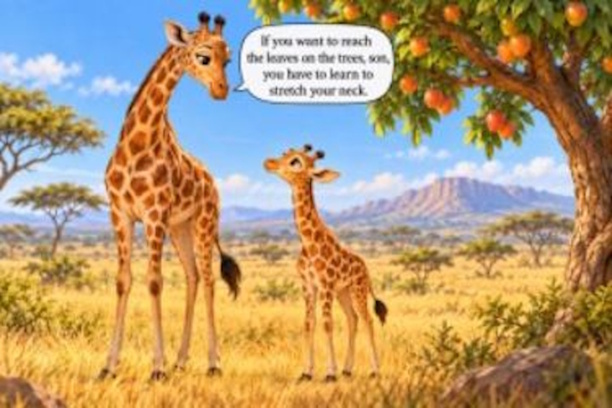
Jean-Baptiste Lamarck (1744–1829) was a French naturalist who proposed an early theory of evolution decades before Darwin published his theory of natural selection. Lamarck believed that species that frequently used a body part would strengthen or enlarge it and that the stronger, larger body part could be passed to its offspring. His most infamous example was that generations of giraffes stretching to reach the leaves on trees would gradually lengthen their necks and their offspring would inherit the increased length.
Which sounds impressive, but the reality is that time is not a magician. Adding millions of years to an explanation does not automatically make the explanation true. If a mechanism cannot be demonstrated to create fundamentally new biological machinery, multiplying the available time does not solve the problem. It merely pushes the problem beyond human observation.
Natural selection unquestionably removes organisms that are poorly suited to their environment, but eliminating the unfit is not the same as creating the fit. A quality-control inspector can reject defective automobiles, but he cannot build an automobile. Selection may preserve a useful biological innovation, but it does not explain the origin of the innovation itself.
That origin is usually attributed to random genetic mutation, but the fact is that most mutations are actually neutral or harmful. Occasionally, a mutation provides an advantage in a particular environment, but Darwinism requires random mutation to do much more than produce a minor advantage. It must ultimately account for wings, eyes, lungs, brains, reproductive organs, consciousness, and the astonishing complex molecular machinery inside every cell.
The most suspect feature of Darwinism may be its flexibility. Similar features are attributed to common ancestry; dissimilar features can be attributed to divergent evolution. All of which sounds nice, but a theory capable of accommodating every conceivable result runs the risk of predicting nothing in particular.
None of this makes evolutionary biology worthless. Modern evolutionary theory has produced useful insights in genetics, medicine, ecology, and epidemiology. But “evolution did it” is not a scientific explanation without an explanation of the actual mechanism behind it.
The central problem is not that Darwin proposed natural selection. His contribution is historically important. The problem arises when a limited biological mechanism is inflated into a universal philosophy that tries to explain life, intelligence, morality, and man himself as mere accidents.
Common sense does not tell us precisely how life came into being, but it does warn us not to confuse a plausible story with a demonstrable fact. And it reminds us that complexity, organization, and information require explanations proportional to their magnitude.
Darwinism may explain certain changes within life, but whether it explains life’s grand architecture is another question entirely—and repeating the phrase “millions of years” is not a scientific answer. Science advances through doubt, testing, and the willingness to abandon inadequate explanations, and Darwinism becomes unscientific when it is protected from those standards.
The reality is that science, by its very nature, can never be “settled,” which has led to the unraveling not only of Darwinism, but many other scientific hoaxes as well.” At considerable expense, we went through all this during COVID with forced vaccinations that didn’t work, forced masks that didn’t work, forced “social distancing” that didn’t work, and more. We were not allowed to question “the science,” especially after Anthony Fauci in effect proclaimed himself to be science.
As Robert S. de Ropp put it in his book The Master Game, “[Man] inhabits a world of delusions and, because of these delusions, makes dangers for himself and others.” In other words, the enemy is us, because we are always so willing to buy into the next great delusion.
Robert Ringer is an American icon whose unique insights into life have helped millions of readers worldwide. He is also the author of two New York Times #1 bestselling books, both of which have been listed by The New York Times among the 15 best-selling motivational books of all time.
From robertringer.com