
IMPORTANT MEETING ABOUT AI TRUTH
Regardless of what you’re hearing, please read some facts you probably aren’t aware of. The threat is Real!
By Rich Loudenback
I asked ChatGPT the following question:
Is there a new data center proposal for Coeur d’Alene or Kootenai County, Idaho?
ChatGPT:
Yes—but it appears to be an older, still-unresolved proposal rather than a newly announced project.
In February 2025, Kootenai County officials confirmed that they had received a zone-change application connected with the intention of constructing a large data center. The publicly searchable records I found do not identify the developer, exact property, proposed electrical capacity, or whether a major technology company would operate it. County meeting record
That application prompted the county commissioners to impose a six-month emergency moratorium on new data-center permits in February 2025. The county was concerned about electricity demand, noise, water consumption and possible effects on the Rathdrum Prairie Aquifer. KREM/KHQ report
The moratorium later expired, and in September 2025 the county adopted permanent regulations:
- Data centers require a conditional-use permit and a public hearing.
- They cannot be located over the Rathdrum Prairie Aquifer.
- Applicants must provide detailed information about power and water use, cooling systems, noise, backup generators, fire protection and eventual decommissioning.
- The county can require additional technical studies. Current Kootenai County data-center code
As of September 11, 2026, I cannot find evidence that a new data center has received approval or begun construction in Coeur d’Alene or unincorporated Kootenai County. Nor do I see a recently announced proposal naming a company and location. The proposal mentioned in the 2025 minutes may have been withdrawn, postponed or simply never advanced beyond the zone-change stage.
So the short answer is: There has been a genuine data-center proposal or inquiry, but I cannot confirm an active, approved project at this time.
Please read below thoroughly AFTER you’ve read all of Tom Deweese’s ‘AI Prison Planet’ so you will understand why we need a meeting to present his facts to our area leaders at a special Speaker’s Bureau Meeting.
WHAT REALLY GOT ME GOING, WAS THIS ARTICLE FROM THE CDA PRESS. Click on the links to see how formidable the attendees to this meeting are in the data center industry.
Sights set on iTECH Summit

CDA Press| September 7, 2026 1:08 AM
COEUR d’ALENE — The Idaho Technology Council (ITC), in partnership with the Coeur d’Alene Regional Chamber, announced the program for iTECH Summit Inland Northwest 2026, taking place Wednesday, Oct. 21, at The Coeur d’Alene Resort.
The event marks ITC’s first program in North Idaho and will bring together business leaders, technology professionals, entrepreneurs, educators, investors, and community partners under the theme, “Tech Powered. Community Led.”
“This program reflects what is possible when technology, business, education, and community leaders come together around a shared vision for the Inland Northwest,” said Diane Temple, president and CEO of the Idaho Technology Council. “It is designed to make space for real conversations about the future of work, the companies and ideas being built here, and the partnerships required to turn innovation into lasting regional opportunity.”
Linda Coppess, president and CEO of the Coeur d’Alene Regional Chamber, said that by bringing technology and business leaders together to exchange ideas, share best practices, and build meaningful connections, “we are creating opportunities for collaboration that can strengthen our businesses and help grow the region’s technology ecosystem.”
An executive panel will explore how AI, technology, and evolving workforce expectations are reshaping leadership, hiring, and operations across the Inland Northwest. Panelists include:
- Rick Rasmussen, CEO, Northwest Specialty Hospital
- Mike Kennedy, President and CEO, Intermax Networks
- Jacob Bonwell, President and CEO, ALTEK Inc.
- Gena Hoxha, Chief People and AI Officer, Ignitium
- Katie McKay, Vice President, MacKay Manufacturing
The summit will also feature “AI Innovators You Should Know,” moderated by Mark Olson, executive coach, advisor, investor, and co-founder of M+L Advisors.
Featured participants include Garrett Oetken, co-founder and head of protocol at Tensora; John Shovic, director of the University of Idaho’s Center for Intelligent Industrial Robotics; Sam Jankovich, CEO of GuideTime; Joni Kindwall-Moore, CEO of The Ryz osphere; and Jen Richey, COO and co-founder of Haiven, Inc.
The morning will conclude with the IDEA² Lightning Pitch Showcase, ITC’s third iTECH pitch competition of 2026. Entrepreneurs from across the Inland Northwest will pitch their business ideas live, one slide and 90 seconds at a time, before a live judging panel and audience.
Before the competition, ITC is partnering with Bill Kalivas and InnovateINW, alongside the Hagadone Technology team, to host September pitch sessions for students and local entrepreneurs. The top three IDEA² winners will receive startup funding prizes, while attendees will select an Audience Choice award.
“Great pitches are built through practice, feedback, and connection,” said Kalivas. “Through September pitch sessions with the Hagadone Technology team, students and local entrepreneurs will have an opportunity to refine their ideas, receive direct and constructive feedback, and connect with experienced founders and Springboard advisors.”
Sarah Gerdes, co-founder of Incluud and author, will deliver the closing keynote, sharing reflections on entrepreneurship, building innovative companies, strategic partnerships, and the opportunity to create technology that strengthens people and communities.
Innovation Tours and VIP Executive Fireside Chat
Between the morning summit and afternoon VIP gathering, attendees can tour the shared Robotics, Automation, and AI Lab, a partnership between the University of Idaho Center for Intelligent Industrial Robotics and North Idaho College X-Labs. The tour offers a firsthand look at how cross-institution collaboration is connecting learning with innovation and workforce opportunity.
“Some of the most valuable insights emerge when people with different experiences come together to learn from one another,” said Marita Diffenbaugh, director of Innovation, North Idaho College.
From 3 to 5 p.m., Hagadone Technology will host an invitation-only VIP Executive Fireside Chat at its Coeur d’Alene headquarters, moderated by Jake Nicklay, director of sales at Hagadone Technologies.
“I’ve been fortunate to be part of the ITC almost from the beginning and this event will be a key cross fertilization opportunity for Tech companies and entrepreneurs in the Coeur d’Alene/Spokane area,” Steve Meyer, founder of Intermax Networks, ITC Board of Trustees, director and inducted into the ITC Hall of Fame in 2014
Register: itc.ticketgoat.com
More data centers, then more energy resources, needed
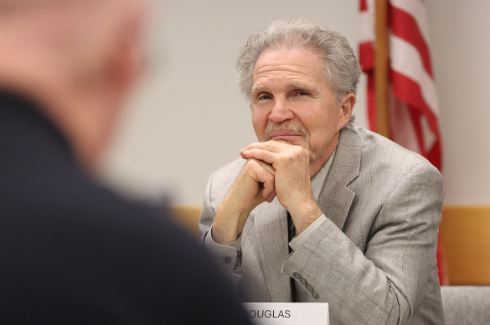
Doug Grob, who represents Montana on the Northwest Power Council and Conservation Council, listens to a public comment given by Jim Robbins in Coeur d’Alene on Monday.
RAY ERKU/Press
by RAY ERKU
CDA Press, Staff Writer | September 15, 2026 1:09 AM
Bracing for a Pacific Northwest influx of data centers and the tech sector over a short-term period, a power planner is calling for more infrastructural needs to meet future electricity demand.
The Northwest Power Council and Conservation Council, a regional organization representing Oregon, Washington, Idaho and Montana, expects its power system to grow 50% to 100% by 2046. This includes long-term impacts and heightened electricity demand caused by electrification of transportation, buildings, and industries as well as population and economic growth.
Current peak demands range from 33,300 megawatts in summer to 35,500 MV in winter. Data from NPCC shows those peaks rising above 60,000 MW in 20 years.
“That’s a lot of load growth,” said Kevin Smit, a NPCC Power Planning Resources manager.
In Coeur d’Alene on Monday, NPCC members, Montana Rep. Doug Grob and Idaho Rep. Ed Schriever, heard public comments over a plan that identifies a regional portfolio to add to the existing power grid between 2027 and 2032, which currently has an estimated capacity of up to 70,000 MW.
The plan, the ninth of its kind since U.S. Congress created the Council in 1980 when it passed the Northwest Power Act, calls for adding 1,060 of average megawatts on top of the 8,247 aMW of total energy efficiency savings added to the regional power system since 1980. This total will be split up – 860 aMW in Oregon and Washington and 200 aMW in Idaho and Montana.
It also looks to add to its power grid 9,000 MW more of renewable energy, which is a balanced mix of solar and solar assets, as well as 5,200 MW more of storage and renewable hybrids and 2,100 MW more of natural gas assets, which includes coal and gas production.
Simply put, the region could see construction of additional wind and solar farms, as well as upping production of coal and gas.
“To meet this moment, the Council sharpened our analysis and evolved our planning methods from our most recent power plan,” Grob said in a prepared statement. “The Council uses innovative modeling techniques and tools that were informed by advisory committees consisting of many of the top experts in the region.”
There were two public comments during Monday’s meeting. They included infrastructural, climate and environmental concerns about the new plan.
Jim Robbins, a Kootenai Electric Cooperative-appointed member of the Idaho Consumer Owned Utilities Association, is a power user who suggested the NPCC to focus more of its plan relying on natural gas resources rather than renewables such as solar and wind generation.
Robbins, who estimated it would take up to 750,000 acres of land to build new wind turbines for the plan, cited various winter cold spells in Washington that have the potential to threaten the power grid. He used a cold spell between 2016-2017 as an example.
“No wind, extreme cold. It was zero degrees in Seattle and -20 on the east side of the Cascades, and I have no idea how cold Montana was,” he said. “And you’re proposing 9,000 (MW) of wind for the very thing that doesn’t show up? I find this dangerous.”
He urged the council to use more dispatchable baseload power production “so that we don’t run out of power during critical times.”
He also said Eastern Washington and Oregon as well as Idaho and Montana “will take the brunt of all these wind turbines.”
Abby Saks is a Spokane resident and Inland Northwest grassroots organizer for Save Our Wild Salmon, nonprofit coalition working to protect and restore endangered wild salmon and steelhead populations. She spoke in favor of the plan to use more renewable energy.
“Our region must work together to limit these impacts of climate change and to do so must foster an energy future where electricity is affordable and clean,” she said, adding, “Our region’s transmission system is severely outdated, which has limited our ability to bring clean energy projects onto the grid.”
Saks also spoke about the negative impacts of relying on fossil fuels.
“As we see the impacts of the climate crisis worsen,” she said, “our salmon populations also continue near extinction.”
With the public comment window open until Oct. 16, the NPCC will likely approve the plan by the end of 2026 or early 2027.
In September and October, additional hearings will be held in Spokane, The Dalles, Missoula, Idaho Falls, and Seattle, as well an online-only webinar, according to the NPCC.
For more information about future hearings or the ninth plan, visit www.nwcouncil.org/energy/ninthpowerplan/