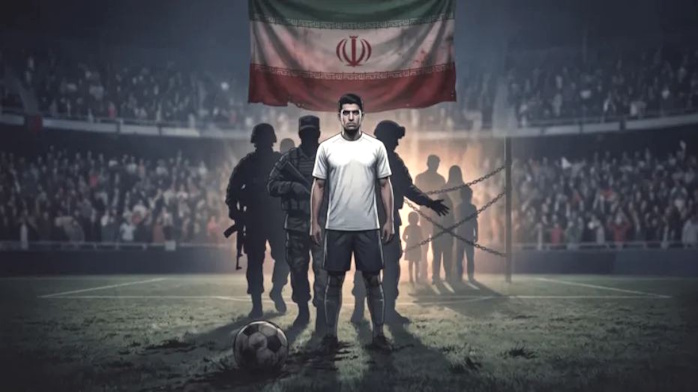
WORLD CUP HOSTAGES – Iran’s players face the regime before every opponent
By Joseph Hippolito .
Order Jamie Glazov’s new book, ‘United in Hate: The Left’s Romance with Tyranny, Terror, and Hamas’: HERE.
During Iran’s last appearance in the World Cup four years ago in Qatar, players refused to sing their national anthem before their first match against England. Their steadfast silence expressed support for the Woman, Life, Freedom Movement arising from the death of Mahsa Amini, who died in custody two months earlier after being arrested for not wearing her hijab properly.
Iranian fans cheered.
But before Iran’s next match against Wales four days later, most of a starting lineup that looked intimidated either sang or mouthed their national anthem’s words meekly as fans jeered.
What happened? Members of the Islamic Revolutionary Guard Corps approached the players between games and threatened their loved ones back home if they continued to protest.
Those incidents exemplify the pervasive control the IRGC holds not only over the national team but over all Iranian soccer. Since the United States and Canada view the IRGC as a terrorist group, both nations refused to grant visas to Iranian soccer officials and support personnel — including Mehdi Taj, president of the national federation, and Hedayat Membini, its secretary general.
As part of the visa restrictions, the national team had to live and train in Tijuana, though all its first-round games took place in Seattle and Inglewood, Calif., a suburb of Los Angeles. After each game, the squad immediately returned to Tijuana.
“The group stage is finished tomorrow and we don’t have our logistics people here,” forward Mehdi Taremi, the team captain and a veteran of three World Cups, said after Iran’s final first-round game Friday. “We don’t have recovery or logistics people to help us. They don’t have a visa.
“We have to fight everything here. FIFA did nothing. It’s not fair. Who wants to help us? It’s a disaster (cq) World Cup, a disaster.”
But consider that Taremi spent most of his career supporting the regime. He not only was a personal friend of the late Iranian president, Ebrahim Raisi, one of Khamenei’s proteges. In 2017, Taremi reposted Supreme Leader Ali Khamenei’s Twitter declaration that Israel would cease to exist within 25 years.
The relationship between the regime and sports began when Khamenei secured the IRGC’s loyalty by promising economic opportunities insulated from financial accountability. As a result, the IRGC expanded into industries ranging from banking to mining to agriculture to construction, and accounts for more than 50 percent of Iran’s gross domestic product.
“Over the past two decades, most sports clubs and related bodies have been taken over by political or security-military organizations, with former Revolutionary Guards holding the top positions,” Kambiz Foroohar, a journalist and consultant, wrote for the Middle East Institute in 2021. “The financial benefits of running a sports club are simply too great for the Revolutionary Guards to ignore.”
Money becomes the reward for exercising political power.
“The Guards see sports as a form of social control to be exploited in pursuit of domestic policy objectives,” Foroohar wrote. “The country’s two most popular sports, wrestling and football, attract a young male demographic, often from poor socio-economic backgrounds, that needs to be managed and directed. Furthermore, sports have a symbolic value, as policies applied to the athletic domain project ideals for society at large.”
The IRGC exerts its power in domestic soccer through the Persian Gulf Pro League. Former IRGC commanders serve as club executives or board members, especially at two of the biggest clubs in Asia: Persepolis and Esteghlal, bitter rivals based in Tehran. The chief executive officer of one mid-level club, working under a double alias, not only was an IRGC commander and the head of security for state television. Amir Mansour Bozorgian-Asl (his real name) belonged to an assassination team that murdered in Vienna the leader of the Democratic Party of Kurdistan, Abdul Rahman Ghassemlou, in 1989, as well as other Kurdish activists elsewhere.
The IRGC even owns one club: Shiraz’s Fajr Sepasi FC, which the unofficial Team Melli website called “the most hated club in Iran!”
Khamenei protected his IRGC allies in soccer by ordering a popular Iranian soccer commentator off state television in 2019 for being too tough on corruption and mismanagement. Adel Ferdosipour, whom Newsweek described in 2009 as one of Iran’s 20 most powerful people, had been covering soccer for two decades.
Corruption flourished under Taj, who was an IRGC intelligence officer at 19 and is serving his third term as president of the Football Federation of the Islamic Republic of Iran. For example, players accused the federation in 2019 of stealing 1.5 million Swiss francs, or $1.3 million, they received for playing in the 2014 and 2018 World Cups. The IRGC even influences the choice of a national coach.
Since the men’s national soccer team represents the sporting world’s most direct connection with Iran, the regime takes great pains to use it to promote propaganda and to enforce political compliance. The team’s official video for this year’s World Cup began with shots of an Iranian flag flying near bomb damage accompanied by a statement of defiance:
“Even if the entire world becomes our enemy, this land belongs to Imam Mahdi, the imam of the time.”
Shia religious imagery and singing dominate the video, which includes an AI-generated image of head coach Amir Ghalenoei with his hands extended in prayer.
Later, players wearing the national white soccer uniform turn into soldiers wearing camouflage and helmets while brandishing automatic weapons.
Authorities spare no expense to ensure compliance. For the 2022 World Cup, the regime spent $2.36 million to send about 350 agents and social media specialists to the tournament. Qatari authorities helped by banning the lion-and-sun flag, symbolic of the deposed Pahlavi dynasty, and other anti-regime messages.
One year later, when Qatar played host to the Asian Football Confederation’s 2023 Asian Cup, undercover IRGC and Basij agents arrived to “boost player morale and be in the presence of international photographers,” Membini said. About 100 of the more than 300 agents attended training sessions while many served as undercover fans. That effort cost the regime about $300,000.
For this year’s World Cup, FIFA capitulated to the demand to ban the lion-and-sun flag but allowed fans to show the Palestinian flag when Iran plays.
Compliance also involves punitive measures. Forward Sardar Azmoun, a World Cup veteran who scored 57 goals in 91 games for Iran and plays in the United Arab Emirates after two seasons with top European clubs, was expelled from the national team in March for appearing in photos with Mohammed bin Rashid Al Maktoum, the UAE’s prime minister and the ruler of Dubai. Iran considers the UAE a wartime enemy.
In 2023, the news agency Tasnim, which the IRGC operates, reported that prominent players were arrested for drinking alcohol, illegal in Iran, and socializing with unmarried women. In 1984, the regime executed Habib Khabiri, Iran’s captain, for supporting political opposition.
During the massive demonstrations in December, January and February, as the regime killed tens of thousands of protesters, Iranian soccer players stood with them. Ali Karimi, who played in the 2006 World Cup and for Germany’s Bayern Munich, joined other former players, a soccer coach, a referee and Iranian sportswriters in an open letter to FIFA, international soccer’s governing body.
Karimi and his fellow signatories demanded that FIFA condemn the regime’s attacks, whose victims included “members of the football community, sanction Iran’s federation for violating FIFA statues and suspend its national teams from all competitions, including this year’s World Cup.
”I have always considered myself one of the people,” said Karimi, who had his property confiscated by the regime and now lives in Los Angeles. “Now that our country is going through one of its most sensitive and sorrowful periods, the least I can do is be the voice of my people.”
Two months later, five members of the national women’s team received asylum in Australia, site of the Women’s Asian Cup, after starters refused to sing the Iranian anthem.
The persecution of Mohammed Rachid Mazaheri, a reserve goalkeeper on Iran’s 2018 World Cup squad, best illustrates the close cooperation between the IRGC and the FFIRI. The federation suspended him in 2019 after he criticized the government for spending money on building soccer stadiums in Iraq. One year later, the IRGC interrogated Mazaheri for protesting the execution of three prisoners. In 2021, he received a second suspension from the FFIRI for supporting mass protests over the severe lack of water.
Then in February, as the regime continued to murder protesters, the IRGC arrested Mazaheri for posting an Instagram picture of Khamenei with the caption, “Satan” and the phrase “Khamenei! Know that your command over this holy land has ended.”
No news about Mazaheri’s fate has since emerged.
Joseph Hippolito
Joseph Hippolito is a freelance writer and a regular contributor to FrontPage. His commentaries have appeared in The Federalist, The Stream, Human Events, American Spectator, Wall Street Journal, Jerusalem Post and National Post.
From frontpagemag.com