The School Trying to Rebuild Education for an AI World
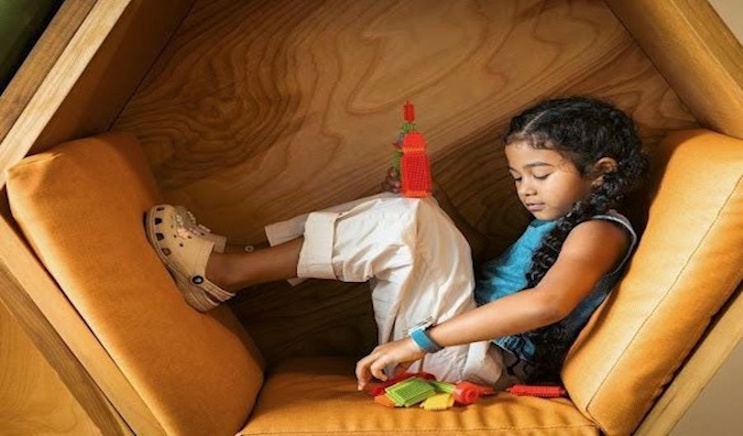
Students at Alpha settle into desks, bean bags, and “zen booths,” where they spend the academic morning learning from AI-powered apps. (All photos via Alpha School)
Maya Sulkin visits Alpha School, where there are no teachers, classes last two hours, and students earn $100 for a perfect test. Is this the future of education?
By Maya Sulkin
05.14.26 —Education
Education
“These are deep investigations—from kindergarten to college—into school choice, the misallocation of resources, and how we can fix our broken school system.”
Fin, a sixth grader, stood up. It was his turn to present his start-up: a streetwear brand named “22.” Pacing around the front of the room, with his foot occasionally falling out of his slides, he talked about the followers he’d get once he dropped his line—and how he was going to take his mom’s credit card to fund it. He also mentioned that his friend “has a connection to the billionaire Joe Liemandt,” the software executive backing Fin’s school.
I had arrived at Alpha, the most expensive private school in San Francisco, where there are no teachers, the academic day lasts two hours, and the kids love school.
The pitch is bold: Students complete all of their schoolwork each morning using AI-powered apps. The afternoons are for “life skills”—workshops on things like entrepreneurship and product design. On the day I visited, students participated in a “yapathon”—a public speaking exercise where they talked about a subject for three minutes and lost points for every filler word (“like,” “um”) they used.
Fin told me he switched from a public school to Alpha in November because “I don’t want to do six hours of academics, and I like building stuff.”
Alpha was co-founded in 2014 by MacKenzie Price, a Stanford-educated entrepreneur who got sick of hearing her daughters say they were bored at school. It opened its first campus in Austin, Texas, more than a decade ago and now operates 22 locations nationwide. The San Francisco campus I visited in March launched in the fall and has 30 students ages 6 to 14.
Alpha relies on an education platform called Timeback, which teaches the same content as the U.S. Common Core curriculum—but instead of a teacher lecturing to 30 kids, an algorithm assesses what each student knows, identifies the gaps, and builds a lesson plan to fill them. The only adults in the room are “guides” who get paid up to $175,000 a year to essentially act as motivational coaches.
Alpha is a radical answer to the questions facing parents and educators in the age of AI: How should we teach kids in a world of ubiquitous screens? How do we prepare kids for the AI revolution? And what does an education even look like in a world where the traditional signs of learning are tasks that can be completed by an LLM in seconds? For every parent enrolling their kindergartner in AI summer camp to learn robot design, there’s a tech executive sending their children to Waldorf schools, where there are no computers in sight. Thirty-four states have enacted laws restricting phones in schools—a bipartisan stampede away from screens that would have been unthinkable a decade ago.
“From Socrates to Plato to Aristotle to Alexander the Great, the elite and the rich had a one-to-one tutor.”
—co-founder MacKenzie Price
But somewhere between AI boot camps and blue books is Alpha School, which is betting on making education as efficient as possible while optimizing real-life skills. “During the morning academic block, if kids are using AI, they’re probably cheating,” Price said. “And if they’re not using AI in the afternoons when they’re building out their passion projects, they’re probably missing something that could give them superpowers.”
The school has its ardent supporters, like Bill Ackman, who has become its de facto ambassador. But it’s gotten a fair share of criticism, too. There are education experts who say technology has no place in the classroom. There are the parents who say Alpha School is just for rich kids, and the students who call the whole thing “bullshit.” In October, Wired published a piece claiming Alpha surveils kids. (An Alpha spokesperson said it’s “common knowledge and all parents are aware that Alpha’s platform uses monitoring when students are physically at school and connected to the school’s Wi-Fi.” Monitoring can be turned off once students are home.) Nine states have rejected Alpha’s charter school applications—including Pennsylvania, where the president of the State Education Association, Aaron Chapin, denounced the program, stating that “AI can help teachers, but it can never replace a teacher guiding a student’s learning in a classroom.”
Price says Alpha’s model isn’t so novel. “From Socrates to Plato to Aristotle to Alexander the Great, the elite and the rich had a one-to-one tutor.” Our current education system, she told me, creates “compliant, obedient, rule-following workers who know how to sit still.”
Before my two days at Alpha, I was expecting this to be a cautionary tale about the dangers of ed-tech. What I found was something different. I met kids who love school and have excelled past their grade levels using Alpha’s learning platform. I also met their parents—people who had identified a deep rot in their children’s prior education and wanted something different: transparency, agency, and preparation for a world that, at the dawn of the AI revolution, feels like it’s changing by the second.
But in the end, it is an educational experiment. And Alpha parents seem okay with that.
“We don’t know what the world’s going to look like. At least this school is talking about it,” said Julia, an Australian who enrolled her son, Ace, in kindergarten at Alpha. “At least this school is showing the tools in a safe environment. At least they are having the conversation, whereas other schools are just trying to do what worked before, and there’s no certainty that it works now. . . . All the jobs I did in my 20s are automated now. It’s scary to me.”
Every morning, students grab their computers from a storage bin, put on headphones, and settle into their desks, bean bags, and “zen booths”—quiet pods for focused work. A 6-year-old in a soccer jersey with blue hair began reading aloud about how elections work, material two grade levels above his age. An 8-year-old was reading African folktales. Every 25 minutes, they’d break, following something called the Pomodoro Technique, a time-management approach to make “deep work sustainable,” where you work in focused intervals to improve concentration and deal “with time pressure and anxiety.” Some kids paused to do push-ups; others just worked through the break.
As I toured Alpha’s San Francisco campus, I met a New Jersey public school teacher who was applying to be a guide. He walked around the classrooms, giddy about possibly leaving his current job, where half of his day is “a battle of negotiating and incentivizing” a classroom of kids who “hate coming to school.”
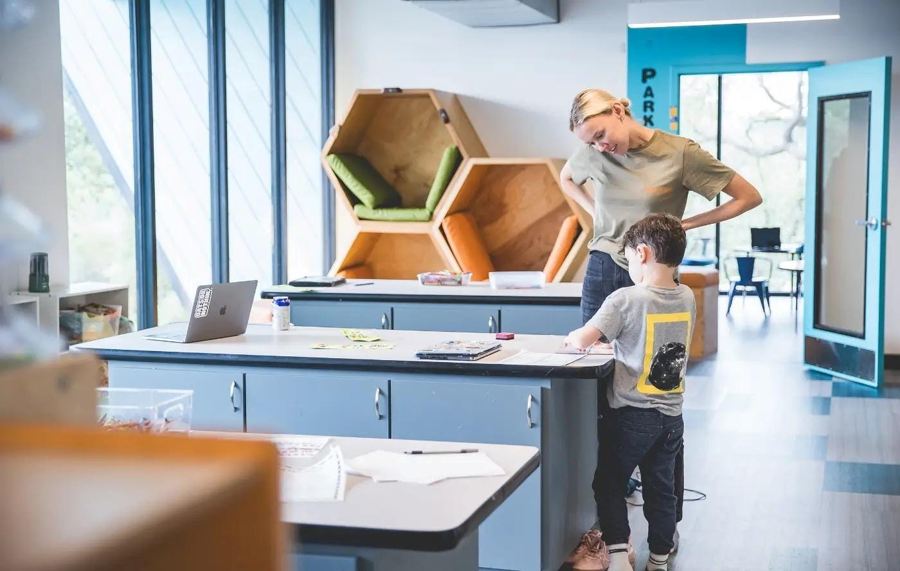 The only adults at Alpha are “guides”—a mix of former reading specialists, ex-tech designers, and camp counselors paid up to $175,000 a year to motivate rather than teach.
“Technology is here to stay,” he told me. Seeing Alpha School in person, he added, only made him more certain.
There are no letter grades at Alpha. Progress is tracked in XP—experience points—where one XP equals roughly one minute of focused learning. Kids fill “rings” (like Apple Watch activity rings) for each subject, and earn “Alpha bucks,” a wooden currency worth 25 cents each, which they can use at the school store or donate to a cause of their choice. Score 100 percent on a test and you get $100 in real money. The guides are a mix of former reading specialists, user experience designers from big tech firms, and camp counselors. They’re not allowed to give academic guidance—for one, they’re not trained to, and they’re there to motivate, not teach.
It’s unconventional, but June Rockefeller, a 14-year-old eighth grader, told me it’s working.
“The problem with the education system now is that they teach to the average student when everybody’s brains work differently,” Rockefeller said. “If there’s a kid ahead, they’re not going to move the entire class ahead for that kid. And then if there’s kids behind, they can’t wait for those kids to catch up. They just have to move with that average student. And that’s where the gaps in education start to build up.”
At Alpha San Francisco, the students start their mornings not by taking attendance but with “Geek Squad”—a 10-minute review of the previous day’s data. They calculate their XP and their Alpha bucks payouts, all visibly tracked on a smart board at the front of the classroom. When a timer went off for a break later in the morning, one kid said he needed “three more XP” before he could stop. Another ran in from the hallway bragging about his score.
Rockefeller told me the Alpha experience is “kind of like you’re playing a video game, but yet it’s still challenging you, but it’s also not incredibly difficult where you’re, like, crying over it and stressed out about it.”
“The problem with the education system now is that they teach to the average student when everybody’s brains work differently.”
—June Rockefeller, a 14-year-old eighth grader
I never spoke about school the way Rockefeller does. My eighth-grade year was spent crying over math homework and hearing my dad quote Aristotle: “Learning is not child’s play; we cannot learn without pain,” at which point I’d roll my eyes. Alpha insists kids are learning grit in other ways.
Tech entrepreneur Austen Allred’s daughter, a 10-year-old at Alpha Austin, didn’t meet the criteria for a trip to Six Flags, which Allred thought they’d make an exception for. Instead, she stayed home and bawled her eyes out, admitting to her parents that she could have tried harder in school.
James Wong, a wealth adviser with two sons—Austin, 9, and Ethan, 13—at Alpha, told me Austin was devastated when he was the only kid who didn’t qualify to go on the rock climbing expedition to Lake Tahoe. But there was a weeklong vacation break before the trip, and the school said if Austin could catch up during that week, he could attend. So Austin went with his mom to the climbing gym three days straight during vacation. On the third day, with calloused hands and blisters, he finally hit the goal and qualified. Wong told me that was the first time his son had ever experienced real failure and had to push through it physically. “At 9 years old, that is not something he had experienced in the traditional school environment,” Wong said.
But are trips to Tahoe and Six Flags the right way to motivate kids? And should school feel like a video game? At most schools, a good grade and a smiley face on a test is enough to satisfy a student. At Alpha, they are working for cold, hard cash and trips.
Julia, the Australian Alpha mom, told me the school is “highly gamified, which we don’t really know the results of, but at the end of the day, he’s learning it.” When Ace comes home, he brags to his parents about the levels he’s progressing to, and how many XP he earned that day. “It’s crazy to see how sticky that is for him,” Julia added.
The question is whether the gamified system can produce not only a person who loves school, but a person who loves learning. Jared Cooney Horvath, a neuroscientist who wrote The Digital Delusion, told me that while gamification works for keeping kids excited, it doesn’t work for retaining information. He drew a comparison to language apps. Duolingo is gamified, and users spend twice as long on it as they do on Babbel, which is not gamified—the Duolingo users are having more fun. But when Duolingo users are out of the app, and try to order at a restaurant in the language they’re trying to learn, they often struggle. He predicts that’s what’s happening to students at Alpha.
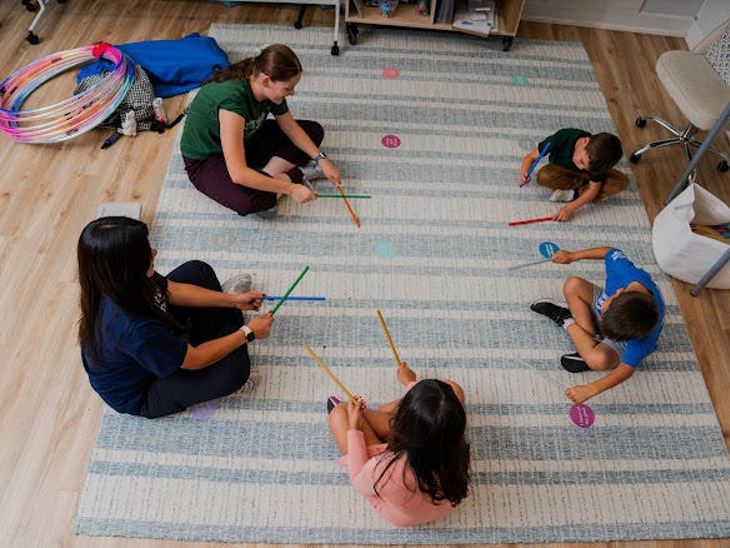 Alpha students spend less time on screens than kids at most traditional schools, according to co-founder MacKenzie Price.
“There’s a lot of effort and circularity when it comes to learning that requires excessive repetition, excessive time, excessive thinking, and failure,” Horvath said. “And that’s where efficiency has never been an operative or meaningful word when it comes to learning. Anyone who says speed and efficiency and learning together—they just made a mistake.”
In response to Horvath’s claims, the Alpha spokesperson said, “Gamified elements are a very small piece of a much larger, rigorously built, science-based system. Alpha is constantly iterating to improve the learning experience and would welcome Dr. Horvath’s review—of the whole model.”

Evidence of a broken education system is everywhere you look. The most recent Nation’s Report Card showed 12th graders posting the lowest math scores in two decades; nearly half scored below the basic level. We’re spending more than ever on education, but reading scores hit historic lows at every grade tested, with only about a third of American students reading at a proficient level.
Rockefeller, who previously attended a top California day school, told me she never scored below a 95 on her report cards at her old school. “I felt so overworked, but didn’t learn anything,” she said. When Rockefeller enrolled at Alpha as an eighth grader, she had to fill in gaps in third-grade writing and science. At first, she was shocked. But then it made sense, Rockefeller said. “I had, like, a semester where I learned all about fermentation in science, and I couldn’t tell you what fermentation is.”
“We’re disincentivized to fail kids,” the New Jersey teacher told me. “It just creates more work for us.”
Sarah Cone, a venture capitalist in New York, pulled her 8-year-old daughter from Avenues—an elite for-profit, dual-language school—because “I didn’t see my child learning anything. I didn’t see her growing. I also didn’t see her having fun, and the children there were just tremendous brats.” She told me she toured Manhattan’s other elite schools, including Horace Mann, and saw “joyless places of exhausted, beaten-down children.”
Read
Everyone’s Using AI to Cheat at School. That’s a Good Thing.
Since enrolling her daughter, a second grader, in Alpha’s New York campus, “everyone is just commenting about what a different child she is,” Cone said. Her daughter gives toasts, she tells me, and speaks “comfortably and eloquently” in front of adults. After six months, her daughter jumped from first- and second-grade testing levels to third and fourth grade.
Critics of Alpha focus on its use of technology. And Price admitted that most tech use in classrooms “has been a failure.” But she says Alpha is using tech smartly, as opposed to other institutions that just give kids a Chromebook and hope for the best. Their Timeback program won’t let a student move forward until they’ve demonstrated mastery. It’s not a free-for-all chatbot education, Price said.
James Wong, the San Francisco Alpha parent, says parents at other nearby private schools complain that their children have “three to five hours of homework,” and it’s “forcing the kids to find avenues like ChatGPT to make their lives more efficient.”
“In the end, the kids are just checked out,” Wong told me. “They don’t want to learn. I don’t want that kind of life for my kid.”
Price said Alpha students spend less time on screens than kids at most traditional schools—the average student spends 98 minutes per day on school-issued devices during school hours alone, not counting homework, personal devices, or after-school use. Notably, every Alpha parent I spoke to described themselves as anti–screen time. Several had taken the Wait Until 8th pledge, a parent-led movement designed to delay giving smartphones to kids until the 8th grade. Julia and her husband, Steve, ban certain Disney shows because the animation is too stimulating, and they’re big fans of Jonathan Haidt, the Free Press contributor and leading proponent of smartphone bans in schools. “There’s good cognitive food and there’s bad cognitive food,” Julia told me. “We don’t seem to make that comparison.”
The question is whether the gamified system can produce not only a person who loves school, but a person who loves learning.
One of Alpha’s selling points is that its students’ Measures of Academic Progress (MAP) scores—the standard assessment of student growth—are skyrocketing. Alpha said its reports show MAP growth rates that are roughly 2.5 times the national median. (According to the Alpha spokesperson, high school students at Alpha scored an average of 1,545 on the SAT. The national average private school SAT score in 2026 is 1,233 out of 1,600).
Rockefeller, 14, went from the 65th percentile in math into the 95th percentile on the MAP in the six months since starting at Alpha in the fall of 2025. The typical term-to-term growth on MAP is roughly 2 to 8 points depending on grade and subject, according to metrics from the Northwest Evaluation Association, which administers the scores.
But Horvath said Alpha students’ MAP scores are not a sufficient measurement for the school’s impact. “If I train online all day, every day, and then you give me a test that is similarly formatted online, you’d better hope I’m very good at that test,” he said.
At 11:30 a.m., the laptops closed and after a lovely catered lunch of vegetable rice bowls on the outdoor patio, the middle schoolers went upstairs for a pitching exercise, where a website generated business ideas they had to stand up and pitch: Sell me a fridge that judges your food choices. Why should bath bombs turn into soup? Pitch socks that never match.
Later in the day I met Alex Mathew, a senior at Alpha Austin, who was in San Francisco for his Alpha X project. (Every high school student needs to build out an idea that can be viable by graduation.) Mathew created an AI therapist teddy bear start-up called Barry. He’s raised $500,000 in pre-seed funding, and is working with a manufacturer in China. His classmates are writing books, building bike parts, and writing plays in hopes of a Broadway debut. This fall, Alpha is introducing a new initiative, an entrepreneurial high school with increased tuition of $150,000—if students don’t make a million dollars by graduation on their start-up, they get a full refund.
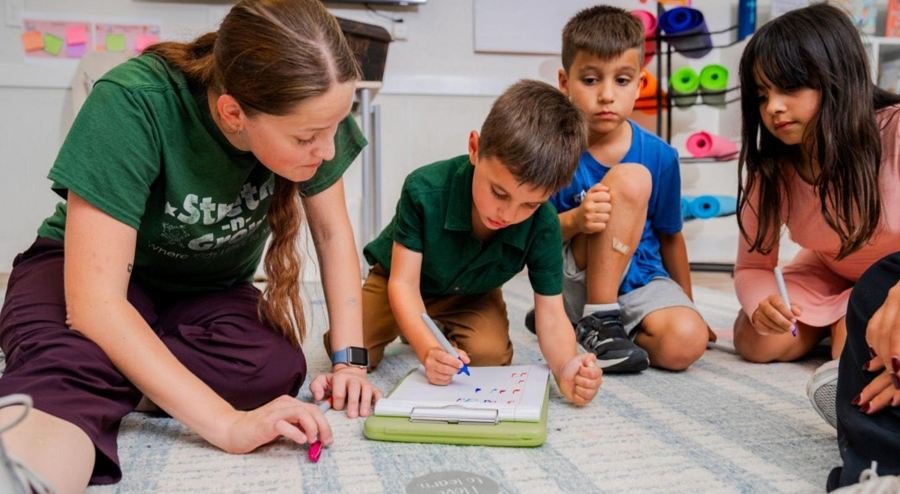 Once the laptops close at 11:30 a.m., afternoons at Alpha are devoted to “life skills”—workshops on public speaking, entrepreneurship, and product design.
Like Mathew, most Alpha students will go to college (only two graduates haven’t). Mathew was wait-listed by Harvard, rejected by Stanford, and accepted to Berkeley, which he plans to attend. “I think it’s gonna be hard for me to sit in a lecture for that long if it isn’t intellectually stimulating for me,” said Mathew, but he thinks college is good for the social elements. “I don’t really intend to get good grades or anything like that because I don’t think that’s the benefit anymore, because I think you can pretty much learn anything with AI,” he told me.
Alpha may encourage this kind of mindset, but Horvath warns that “We’re gonna have an entire generation of kids who want to be entrepreneurs. But great, that’s 1.001 percent of the population. What are the rest of us gonna do?”
Take Alpha’s Brownsville, Texas, campus. It was one of the school’s earliest locations, set in a predominantly Hispanic, low-income community near the border. Families paid a reduced tuition of $10,000, and many paid less with Alpha’s help. It was positioned as proof that the model could work for everyone, not just the tech elite. But a mother who enrolled her children there for two years described a very different experience than the one I saw in the Marina. Her kids were regularly working more than the advertised two hours a day, but they were still behind. And the school’s motivational framework—the same XP and Alpha bucks system that had June filling her rings with a smile in San Francisco—had the opposite effect on her kids, who internalized their failures as evidence that they “didn’t want it bad enough.”
“Alpha might work as a private school for the elite,” the mother wrote on Substack, under the byline JeskaLuv. But she said the experiment didn’t work for kids like hers.
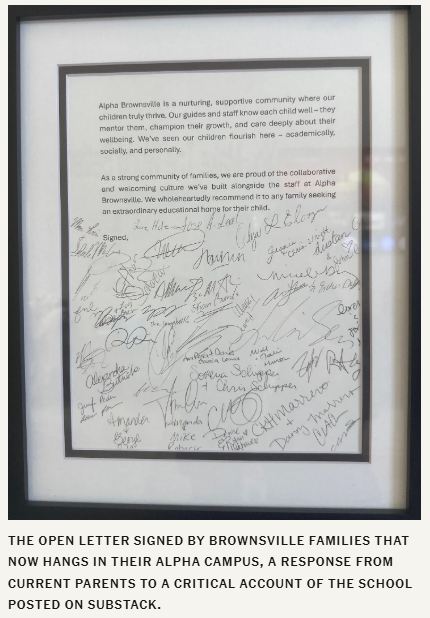
The open letter signed by Brownsville families that now hangs in their Alpha campus, a response from current parents to a critical account of the school posted on Substack.
The Alpha spokesperson told The Free Press that “100 percent of the current families [at the Brownsville campus] signed an open letter to state they don’t recognize their school in that single person’s account.” That letter hangs in the Brownsville school today. The spokesperson added that the students referred to in the Substack dramatically improved in their MAP scores for both math and reading.
Yet Price, when I spoke with her, was candid about who Alpha currently serves. “Alpha is a product as a school that is catering to a certain demographic,” she told me. “It is a premium, expensive private school.” Alpha recently launched a $40,000 summer day camp in the Hamptons where kids will learn to make omakase meals and build a giant Trojan horse, which will be burned in a bonfire at the end of summer.
More on AI

Have Money to Lose? Bet on Allbirds’ AI Pivot.

The Filmmaker Using AI to Beat Hollywood

Why I Co-Authored a Book with ChatGPT
AI Is Coming. Becoming an Electrician Won’t Save You.
But Alpha’s ambitions extend beyond coastal havens like the Marina District and Long Island. Alpha is expanding to more than 35 locations next fall—including Chicago, Puerto Rico, and Atlanta. Several existing locations have wait lists.
The school says its long-term mission is to scale the model to a billion kids. Alpha has already licensed Timeback to other schools, including Texas Sports Academy, an Austin-based school that pairs a two-hour academic model with full afternoons of athletic training.
James Wong and other parents I spoke to said they are all in. It’s naive, they argued, to stick with the boilerplate and expect different results.
And Alpha parents want results.
Sarah Cone said Alpha is preparing her daughter do what she did—start a VC fund—but younger, and faster, and better. “If you can start doing companies earlier, you can get in, like, one company every decade,” she told me. “That’s what I personally hope she does.”
The Free Press earns a commission from any purchases made through all book links in this article.
From the fp.com