
WA Governor Ferguson Has Abandoned His Own Tax Relief Demands
By Ryan Frost
Governor Ferguson announced today that he will sign the latest version of what supporters are calling the “Millionaires’ Tax,” a politically convenient label for a state income tax. If signed, this governor will have enacted the largest tax increase in state history and a brand-new income tax, all within his first two years in office.
The governor’s statement frames the revised bill as a win for affordability, touting expanded Working Families Tax Credit eligibility, free school meals, childcare funding, and new sales tax exemptions. But the state could fund every one of those priorities today if the legislature exercised spending discipline on its existing $80+ billion operating budget.
Instead, these provisions are being used as justification for an entirely unnecessary new tax, bundled with a poison pill that repeals the meager tax relief if the income tax is ever struck down or repealed by voters.
Does It Meet Governor Ferguson’s Requirements?
Gov. Ferguson has requested that a majority of the ~$3.5 billion in annual income tax revenue, around $1.9 billion, be returned to taxpayers.
Here are how his requests compare to the version of the income tax bill he says he will now sign:
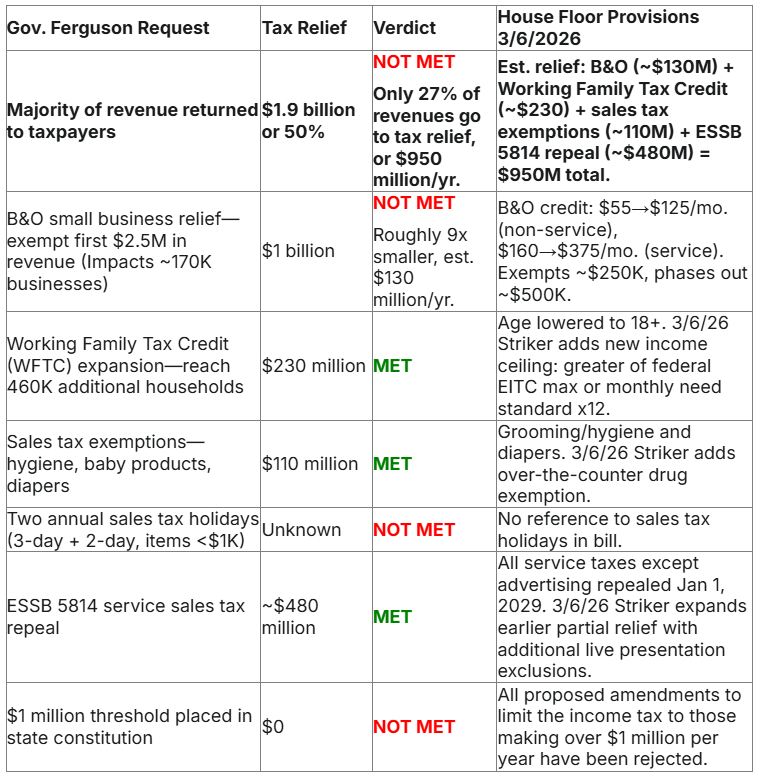
It is not clear why Governor Ferguson would support the current bill under consideration, given that it represents a significant departure from what he said he wanted to see in the bill. Worst of all – despite the Governor’s insistence that at least $1.9 billion (a majority of the revenue) be returned to taxpayers, the current bill only provides around $950 million in relief, meeting only half of that goal.
The Governor’s willingness to fold on a bill that so clearly violates his own public statements suggests that his commitment to taxpayer relief was more a matter of optics than a genuine legislative requirement.
About the Author
RYAN FROST – Director, Budget and Tax Policy
From washingtonpolicy.org