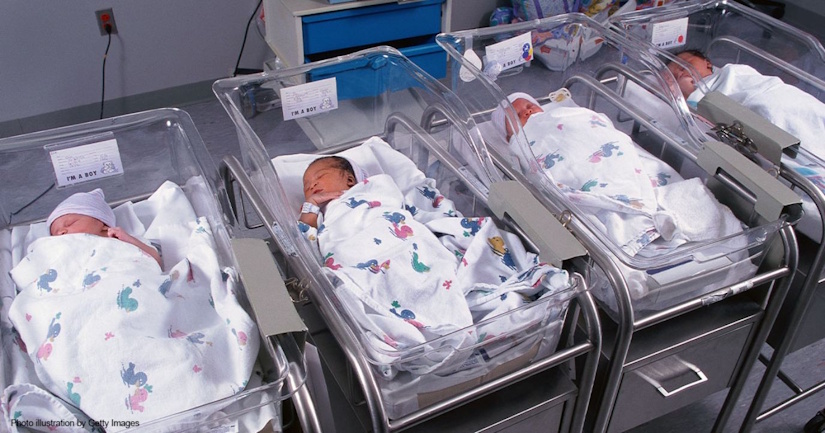
Made in America: Buying Baby Boys on a Mass Scale
As collapses in moral norms go, it is as thorough as one can imagine. On December 13, The Wall Street Journal released a report on a Chinese video-gaming executive who has used surrogacy arrangements in the United States and elsewhere to “father” more than 100 baby boys, at least 12 of them U.S. citizens. Every emerging detail in the story only deepens its repugnance:
- The Chinese executive, Xu Bo, is just one of several Chinese billionaires engaged in commercial baby acquisition in the United States due to its having what the Journal calls, with understatement, a “largely unregulated surrogacy industry.”
- Foreign buyers of American babies may be spending up to $200,000 per child, working through a network of law firms, surrogacy agencies, and service providers (purchasers can arrange nannies for their children in the U.S. and have them shipped overseas to China when the buyer is ready to receive them).
- Xu appeared by video in a court hearing in the summer of 2023 and told the judge that “he hoped to have 20 or so U.S.-born children through surrogacy — boys, because they’re superior to girls — to one day take over his business.” He refers to himself, the Journal says, as “China’s first father” and is known there as a “vocal critic of feminism.”
- In addition to offering an unfettered legal environment, the surrogacy industry offers plutocrats a way to gain children with U.S. citizenship under current interpretation of the 14th Amendment to the U.S. Constitution.
- Mega-billionaire Elon Musk, who has at least 14 known children by relationships with several women, including surrogacy and in vitro fertilization, is an inspiration to the Chinese executives who see themselves as building family dynasties.
- Other Silicon Valley figures like Peter Thiel, engaged in a wide variety of futuristic and transhumanist enterprises, are expanding surrogacy investments; in Thiel’s case, he reportedly provided early and more recent funding for Rhea Fertility Clinic, a Singaporean lab offering surrogacy services to South Asian customers and what it calls “other markets” around the globe.
- Thiel’s Founders Fund is another player in the surrogacy industry, providing money for companies like Nucleus and Herasight, which are working on genetic screening and other techniques they believe will produce better babies for discriminating parents.
- California, a state that offers no substantive legal protection to the life of an unborn child, is a player in nearly every story about the lengths to which commercial surrogacy has gone to stoke and meet market demands.
These facts read like excerpts from a sci-fi novel, or from the classic genetic selection film “Gattaca,” offering glimpses of a dystopian future in which children are a product of transactions between individuals who bear no relation to and may never meet one another. But these developments are not futuristic science fiction; they represent the global present and they rely on the ability to completely separate sex, pregnancy, and birth from person-to-person human relationships. Love and marriage are in the rearview mirror, and the range of harrowing variations grows almost daily.
- In Quebec, a polyamorous throuple, in this instance three men, are waging a legal battle so that each of them is recognized as the parent of an infant girl they adopted after two years of providing foster care.
- In Pennsylvania, a male homosexual couple successfully obtained an infant via surrogacy despite the fact that one of the men is a Tier 1 registered sex offender, which did not apparently deter the couple from parading the infant on social media and setting up an online funding campaign to pay for the surrogacy.
- One online surrogacy agency offers a “two-minute quiz” to aid potential mothers to determine if they are a good fit to bear a child for “intended parents.” The agency writes, “At Worldwide Surrogacy Specialists, we recognize the dedication and commitment of our surrogates. That’s why we offer generous compensation packages and unparalleled surrogate support.” One page states, “Surrogacy is a life-changing experience for both intended parents and surrogates.” The baby’s changed life is not mentioned.
- Another agency offers an information packet to be mailed after completion by the surrogate of a “short questionnaire.” Without elaboration, the web page shows three women with a manifestly pregnant woman in the middle and the “intended parents” with their hands splayed across her pregnant belly. The agency writes, “We can match you right away or move a bit slower; you decide what’s right for you and your family.”
- Yet another agency states the monetary interest plainly. It pitches, “Join a trusted surrogacyagency with 35 years of IVF experience. Apply now. Feel safe, supported, and valued. Apply to become a Harmony Surrogate” Payment of “$65k-$95k” is the lede.
The tone and content of site after site reflect the lack of meaningful public policy deliberation about the wisdom of these practices, given the range of uses to which they are being put and the eugenic outcomes they subtly or brazenly promote. It has been nearly 40 years since the complex legal, social, and emotional reality of surrogacy arrangements dawned on the national scene in the “Baby M” case. The saga of Marybeth Whitehead’s efforts to reclaim the child she agreed to bear for an infertile couple dominated national headlines for months.
Over time, surrogacy arrangements have migrated toward what is called “gestational surrogacy,” where the baby has no genetic relationship to the woman who bears him or her. For some, the lack of a genetic connection to the child weakens the case of the woman who would claim rights to the child she has borne for others. In reality, the various combinations — the mother as the source of an ovum, the mother only carrying the child but providing no egg cell, the mother as both genetic parent and child bearer, the mother absent in a same-sex relationship, same-sex mothers either or neither of whom is related to the baby — have become commonplace while they remain unregulated and unexamined.
Various groups in favor of regulating or ending commercial surrogacy have emerged over time, none more impactful than the Center for Bioethics and Culture in California. Helmed by Jennifer Lahl, R.N., M.A., the CBC has produced a series of films that examine the issues raised by surrogacy as practiced today. Lahl describes the lack of research on the impact of surrogacy procedures and the absence of informed consent regarding its risks to both mother and baby as the result of financial motivations for providers.
“Surrogacy is driven by contracts and most often by money,” she says. “Essentially a woman is hired to perform a service; in this case the service is a pregnancy, resulting in the delivery of a child, who is to be handed over to another person. The infertility industry and those who hire a woman and contract with a woman need to depersonalize her and her role in order to justify using, paying, hiring — whatever word you prefer — her for her services.”
Every case of surrogacy does not sink to the depth of the Xu Bo debacle. But the case does highlight in extreme form the tragic heart of the matter. Commercial surrogacy represents the buying and selling of a human being, with no recognition of the right of a human not to be bought or sold. The agency websites make little or no reference to the child himself or herself, who can become just another design project for a videogame mogul destined to fulfill some messianic role in a business that the child bears no relation to.
Moreover, that child is typically bereft of a natural family lineage, beginning with the mother who, at minimum, has carried him to term. More and more is being learned daily about the physical and psychological bonds that form every day in utero, in the process called fetal-maternal microchimerism, irrespective of the mother’s genetic connection to the baby.
In a recent conversation with a family member, I learned about practices at kennels where dogs are, as a matter of the puppy’s best interest, required to remain with the maternal canine for a period of 10 weeks or more before going to the adoptive home. The Cornell University Canine Health Center states the matter plainly: “[T]he time your puppy spends with their mother and siblings is critical for development, and so it’s important to make sure they spend this growth period with their litter.” Experience shows that such bonding time for the young dog has significant impact on the animal’s health and behavior down the road. A good breed needs his or her mother.
But the surrogate child gets no such consideration and is likely to be whisked away to non-parents straight from the hospital or soon after. Shipment overseas, as we have seen, occurs in some cases. When human lives are treated with less regard than even the most royal of pups, something is gravely amiss.
Chuck Donovan served in the Reagan White House as a senior writer and as Deputy Director of Presidential Correspondence until early 1989. He was executive vice president of Family Research Council, a senior fellow at The Heritage Foundation, and founder/president of Charlotte Lozier Institute from 2011 to 2024. He has written and spoken extensively on issues in life and family policy.
From washingtonstand.com